
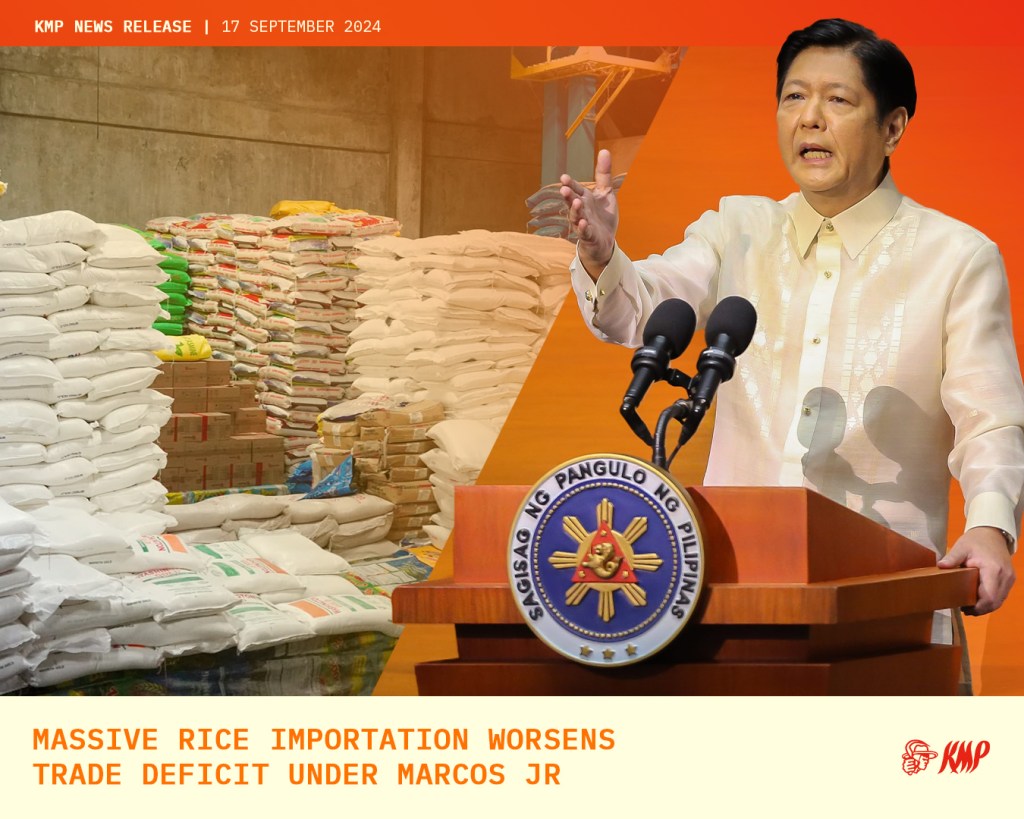
The Kilusang Magbubukid ng Pilipinas (KMP) has attributed the country’s growing trade deficits in part to the large-scale importation of rice and other agricultural goods. According to the peasant group, these imports contributed to trade deficits of ₱66.94 billion in 2022 and ₱52.4 billion in 2023, and the trend shows no signs of slowing. In the second quarter of 2024, the agricultural trade deficit expanded by 13.8%, rising to $3.07 billion from $2.7 billion in the same period the previous year. Agricultural imports grew by 14.1%, reaching $4.94 billion and accounting for 15.5% of the country’s total imports during this period, based on the latest data from the Philippine Statistics Authority (PSA).
KMP Chairperson Danilo Ramos highlighted that the combination of a weakening peso and rising imports is a formula for further widening the trade deficit. “The peso only began recovering this September after months of depreciation against the dollar. It’s clear that the agricultural trade deficit will continue to grow throughout this quarter and by the year’s end,” said Ramos. The depreciation of the peso makes imported goods more expensive, particularly those priced in dollars, such as petroleum and fertilizer, which are critical for the agricultural sector. This has also contributed to higher inflation, with rising oil prices putting additional pressure on the economy.
Despite a struggling local economy, President Marcos Jr. continues to prioritize increasing rice and agricultural imports. Data from the Department of Agriculture shows that rice imports reached 2.9 million metric tons (MT) as of the first week of September 2024, up 20% from the 2.4 million MT imported in 2023. The Bureau of Plant Industry (BPI) reported that from September 1 to 5 alone, 38,068 MT of rice were imported, while August recorded 361,724 MT. The average monthly rice import volume for the first half of 2024 was approximately 400,000 MT.
Ramos further explained that the peso’s weakest point during the first half of 2024 exacerbated the agricultural trade deficit. “Despite the record-high volumes of imported rice, retail prices remain unaffordable for most consumers,” he added. Even with the reduced tariffs authorized by Executive Order 62, KMP does not expect a significant reduction in rice prices. #
 updates from the peasant movement of the Philippines