
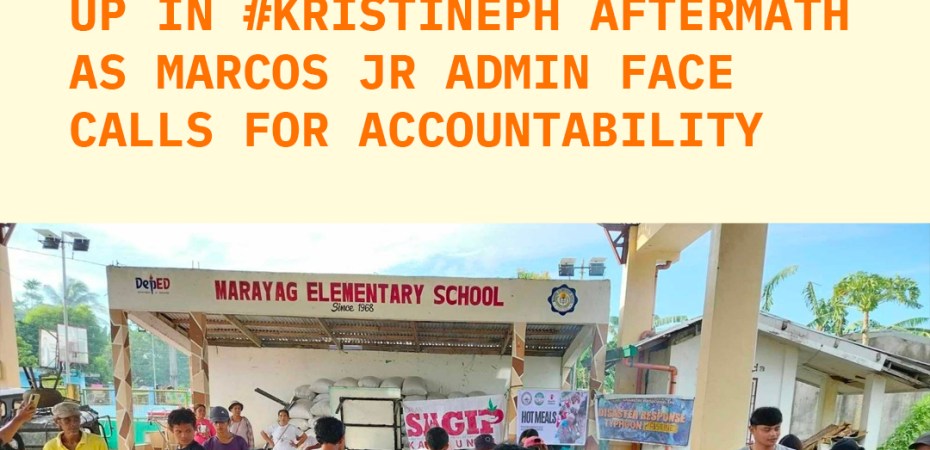
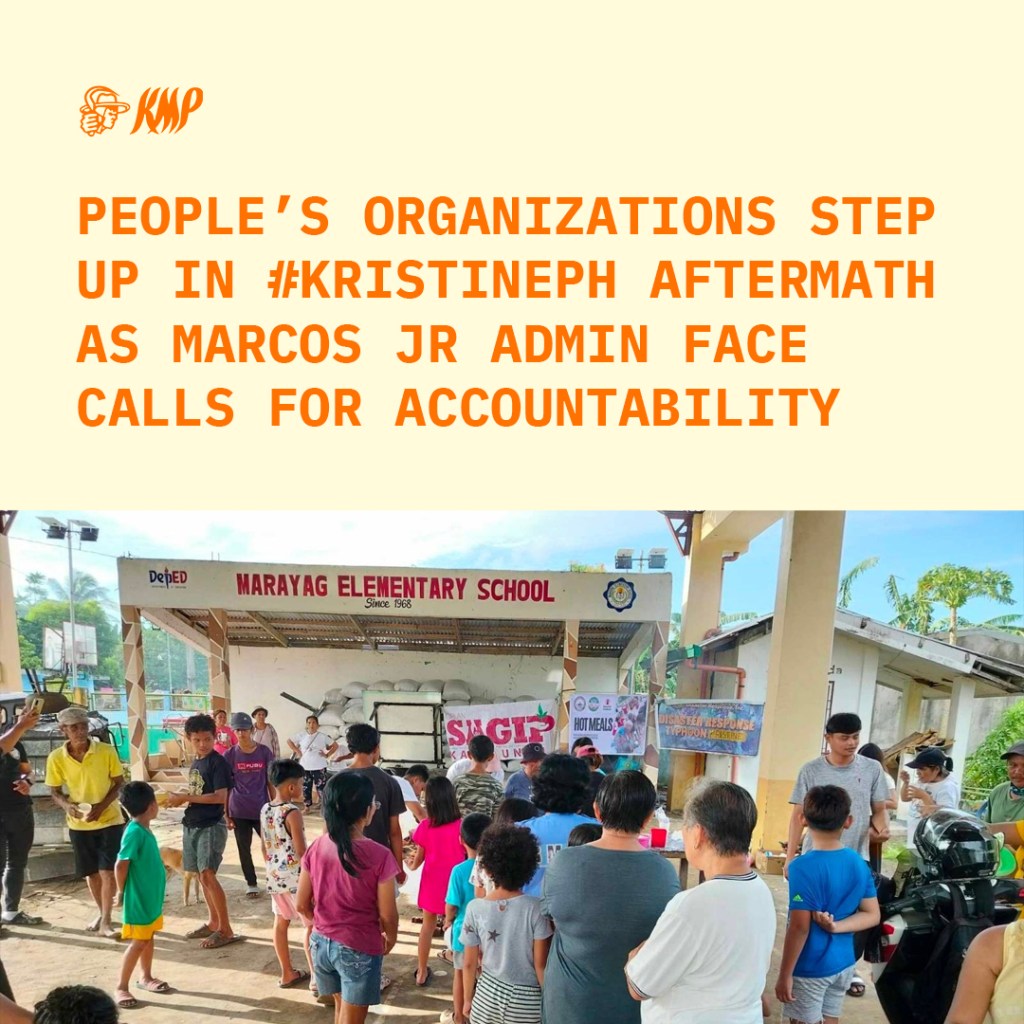
In response to the devastation left by Storm Kristine, people’s organizations in Bicol have launched community-based relief efforts to support hard-hit communities amid widespread flooding and government inaction. Peasant organizations are joining the efforts.
On October 26, 2024, the Bikol Movement for Disaster Response (BMDR) mobilized relief operations, providing mobile hot meals to over 800 residents in Brgy. Balangibang, Polangui, and Brgy. Marayag, Libon in Albay. The initiative was made possible through a network of people’s organizations, local NGOs, various donors, and barangay councils, highlighting the importance of community solidarity in disaster response. Relief network Sagip Kanayunan launched a donation drive to aid farmers, fishers and rural communities in typhoon-stricken Bicol provinces.

The two barangays, known for their expansive rice fields spanning over 200 hectares, have seen consecutive losses due to Typhoons Enteng and Kristine. Nearly 85 hectares of crops that were set for harvest in late October now lie in ruin, with farmers reporting agricultural losses of up to 90 percent. Barangay leaders and local farmers are urgently calling on the Marcos administration and the Department of Agriculture for targeted support, such as rebuilding vital infrastructure—irrigation systems, dikes, roads, schools, and barangay centers.
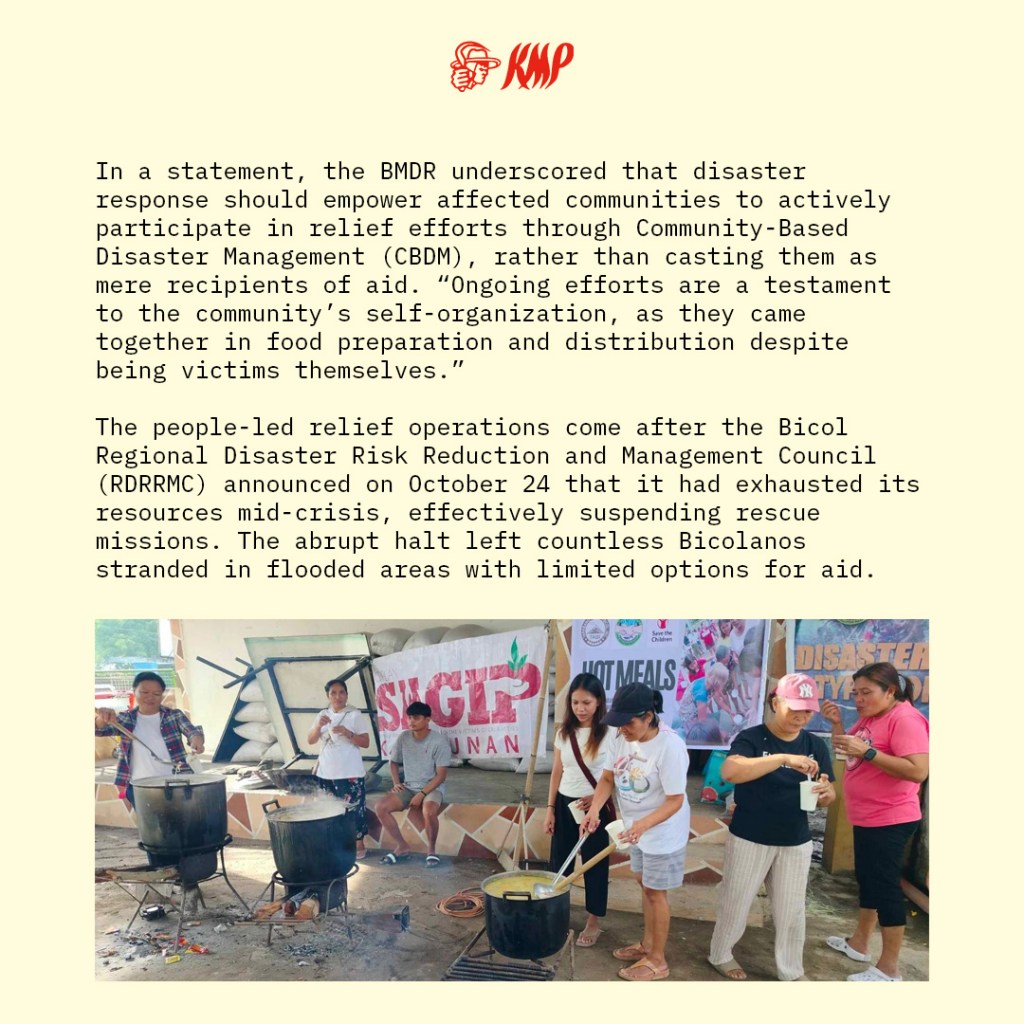
BMDR volunteers are conducting independent relief efforts across Albay, Camarines Sur, Sorsogon, and Camarines Norte, performing Damage, Needs, and Capacities Assessments (DNCA) and distributing hot meals to communities still submerged in floodwaters.
In a statement, the BMDR underscored that disaster response should empower affected communities to actively participate in relief efforts through Community-Based Disaster Management (CBDM), rather than casting them as mere recipients of aid. “Ongoing efforts are a testament to the community’s self-organization, as they came together in food preparation and distribution despite being victims themselves.”
The people-led relief operations come after the Bicol Regional Disaster Risk Reduction and Management Council (RDRRMC) announced on October 24 that it had exhausted its resources mid-crisis, effectively suspending rescue missions. The abrupt halt left countless Bicolanos stranded in flooded areas with limited options for aid.
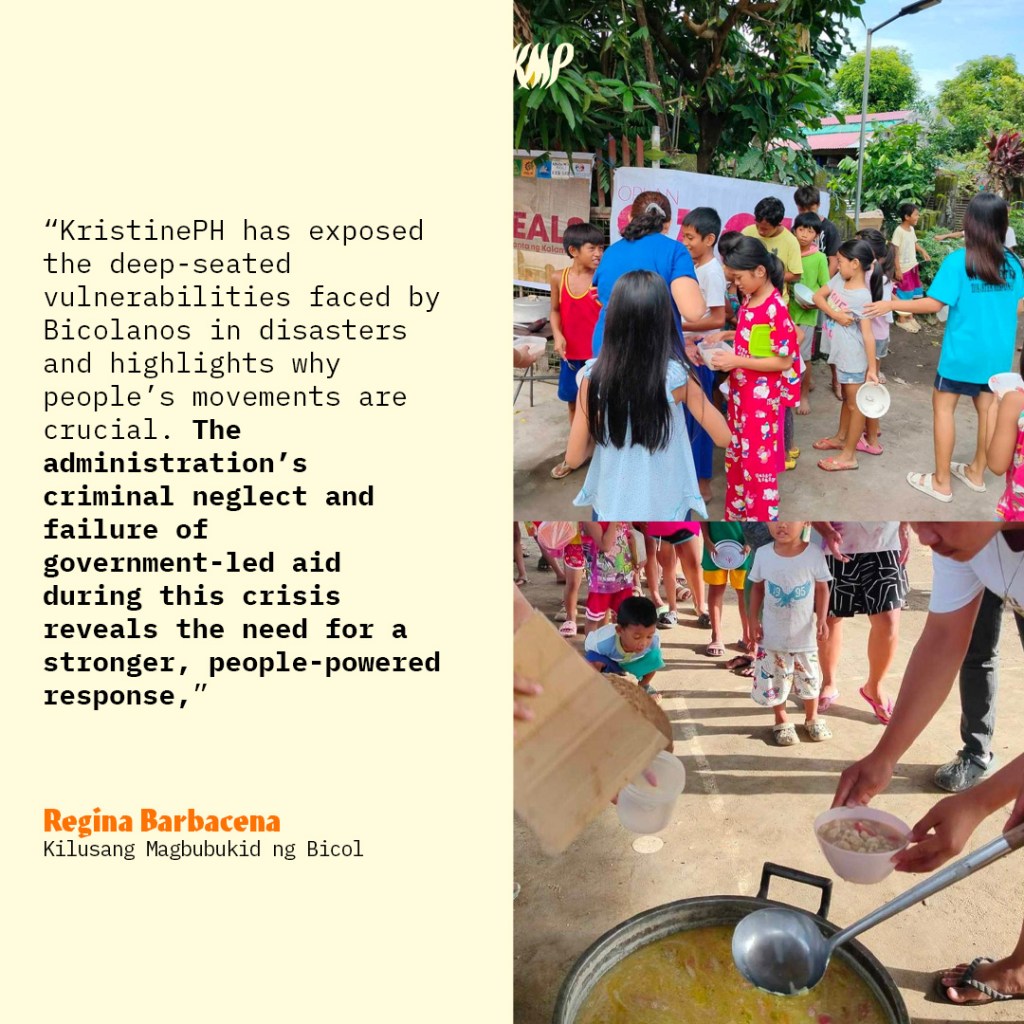
For its part, the Kilusang Magbubukid ng Bicol (KMB), KMP’s chapter in the region said, “KristinePH has exposed the deep-seated vulnerabilities faced by Bicolanos in disasters and highlights why people’s movements are crucial. The administration’s criminal neglect and failure of government-led aid during this crisis reveals the need for a stronger, people-powered response,” according to Bicol-based peasant leader Regina Barbacena.
“The massive flooding, landslides, and erosion illustrate years of unchecked deforestation, extensive quarrying, and substandard infrastructure. It is imperative that local governments and relevant agencies fulfill their responsibility to provide aid, not leave it solely to non-governmental groups,” said KMP chairperson Danilo Ramos.
As the affected communities rebuild from the devastation, BMDR reiterates its commitment to support Bicolanos while demanding accountability from the Marcos administration. “The primary duty of the government is to protect and assist its citizens, especially during disasters. We will continue to demand that the government strengthen its disaster response, prioritize infrastructure and flood controls, and address the root causes of our vulnerability, including destructive land use conversion projects.”
KMP calls on all Bicolanos to stand in solidarity with their communities and hold the Marcos administration accountable for its inaction during this crisis, as well as for policies that continue to exacerbate climate risks and community vulnerabilities.
The peasant group further said that agricultural losses due to successive disasters this year are on track to exceed the annual average. On average, typhoons cause a loss of around 600,000 metric tons of rice production annually. With the onslaught of #KristinePH on major rice producing provinces, the damage to agriculture and volume loss in rice and various crops could be unmanageable. KMP warns that these multi-billion-peso losses in rice and crop production will inevitably cause severe financial hardship for thousands of farmers.
“This situation justifies the demand for aid, compensation and indemnification for farmers,” Ramos concluded. #
 updates from the peasant movement of the Philippines