
Days after the Philippines hosted the Asia-Pacific Ministerial Conference on Disaster Risk Reduction and President Ferdinand R. Marcos Jr. called for a “safer, inclusive, adaptive, and disaster-resilient future,” severe tropical storm KristinePH (international name: Trami) struck the country, impacting over 900,000 families or 4.2 million individuals in its path. The storm left 85 fatalities* and caused over PHP4.36 billion* in initial damages. (*reported data as of October 27, 2024).
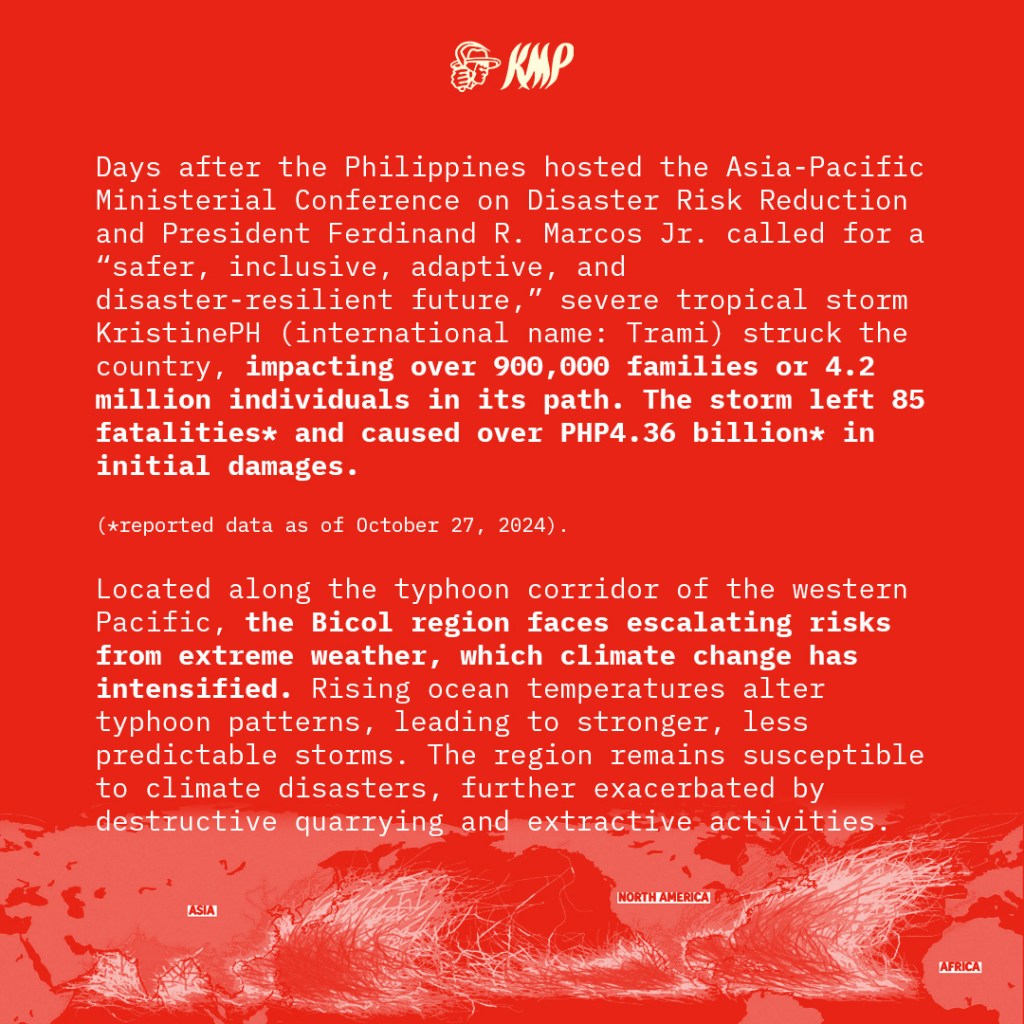
Located along the typhoon corridor of the western Pacific, the Bicol region faces escalating risks from extreme weather, which climate change has intensified. Rising ocean temperatures alter typhoon patterns, leading to stronger, less predictable storms. The region remains susceptible to climate disasters, further exacerbated by destructive quarrying and extractive activities.
Quarrying around Mount Mayon: Fueling lahar flow risks and worsening floods
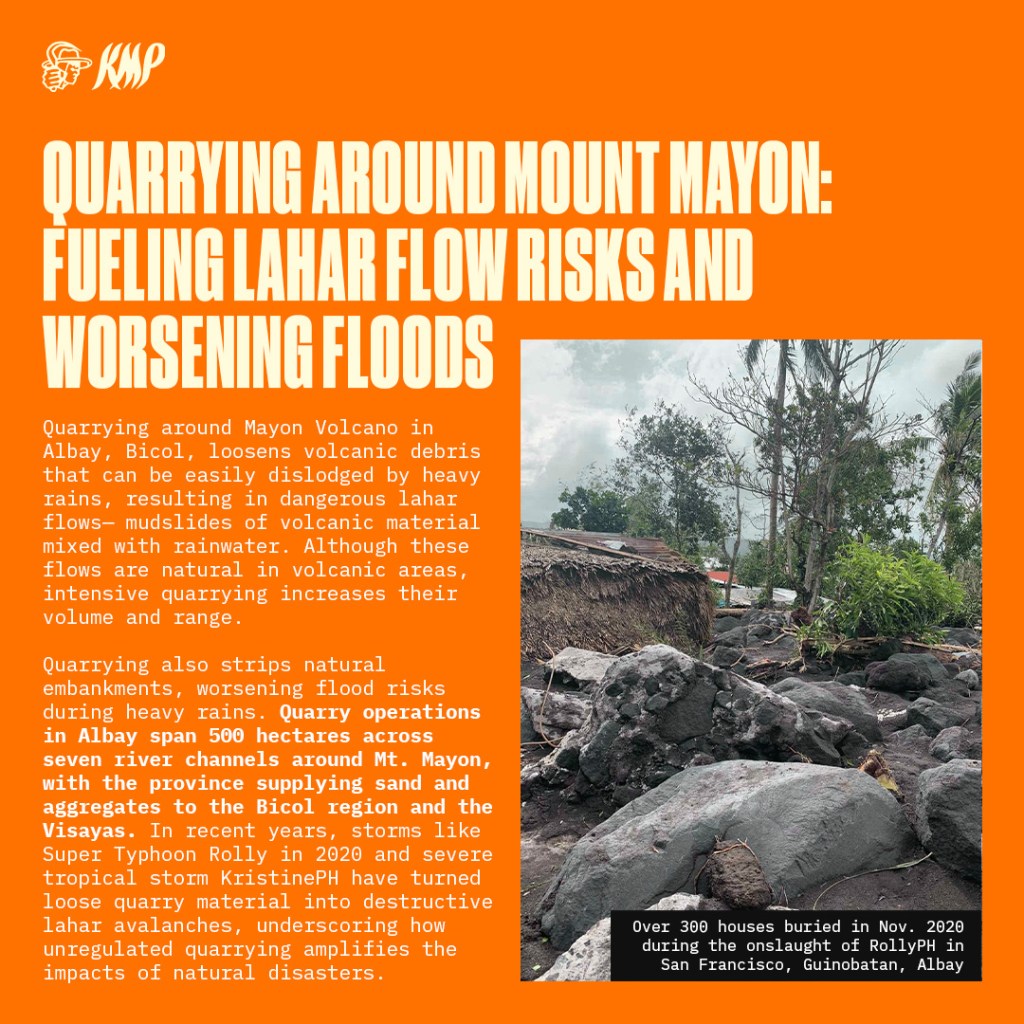
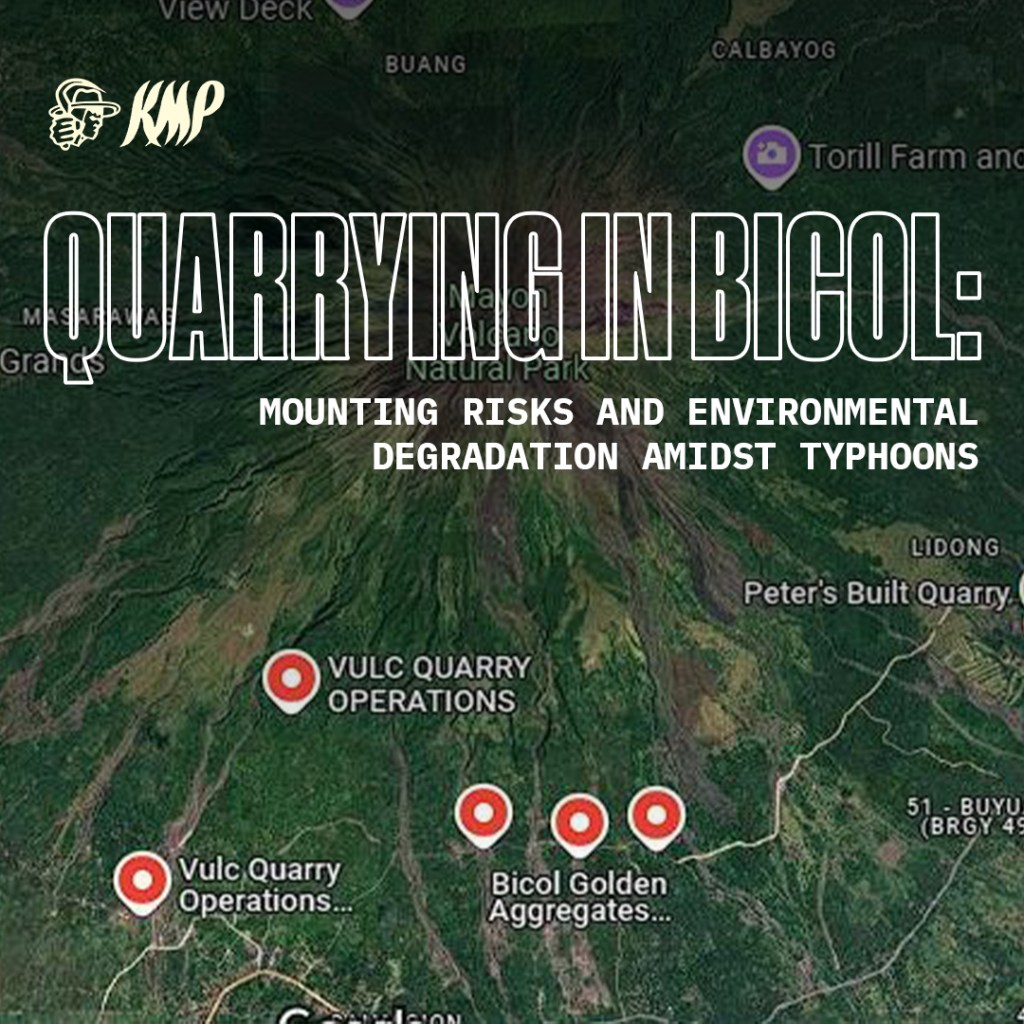
Quarrying around Mayon Volcano in Albay, Bicol, loosens volcanic debris that can be easily dislodged by heavy rains, resulting in dangerous lahar flows— mudslides of volcanic material mixed with rainwater. Although these flows are natural in volcanic areas, intensive quarrying increases their volume and range.
Quarrying also strips natural embankments, worsening flood risks during heavy rains. Quarry operations in Albay span 500 hectares across seven river channels around Mt. Mayon, with the province supplying sand and aggregates to the Bicol region and the Visayas.
In recent years, storms like Super Typhoon RollyPH in 2020 and severe tropical storm KristinePH have turned loose quarry material into destructive lahar avalanches, underscoring how unregulated quarrying amplifies the impacts of natural disasters. KristinePH’s damage in Bicol has reignited calls for accountability, as quarrying once again worsened flooding and lahar flows, displacing hundreds of families.
Reports indicate that many quarry operations around Mt. Mayon lacks sufficient oversight and often operates without the required permits, leading to mismanaged and overextended excavation sites.
While local governments argue that quarrying supports the economy by providing sand, gravel, and ash for construction projects nationwide, the industry has raised long-standing concerns. Extreme weather events amplify the already dangerous environmental risks associated with quarrying.
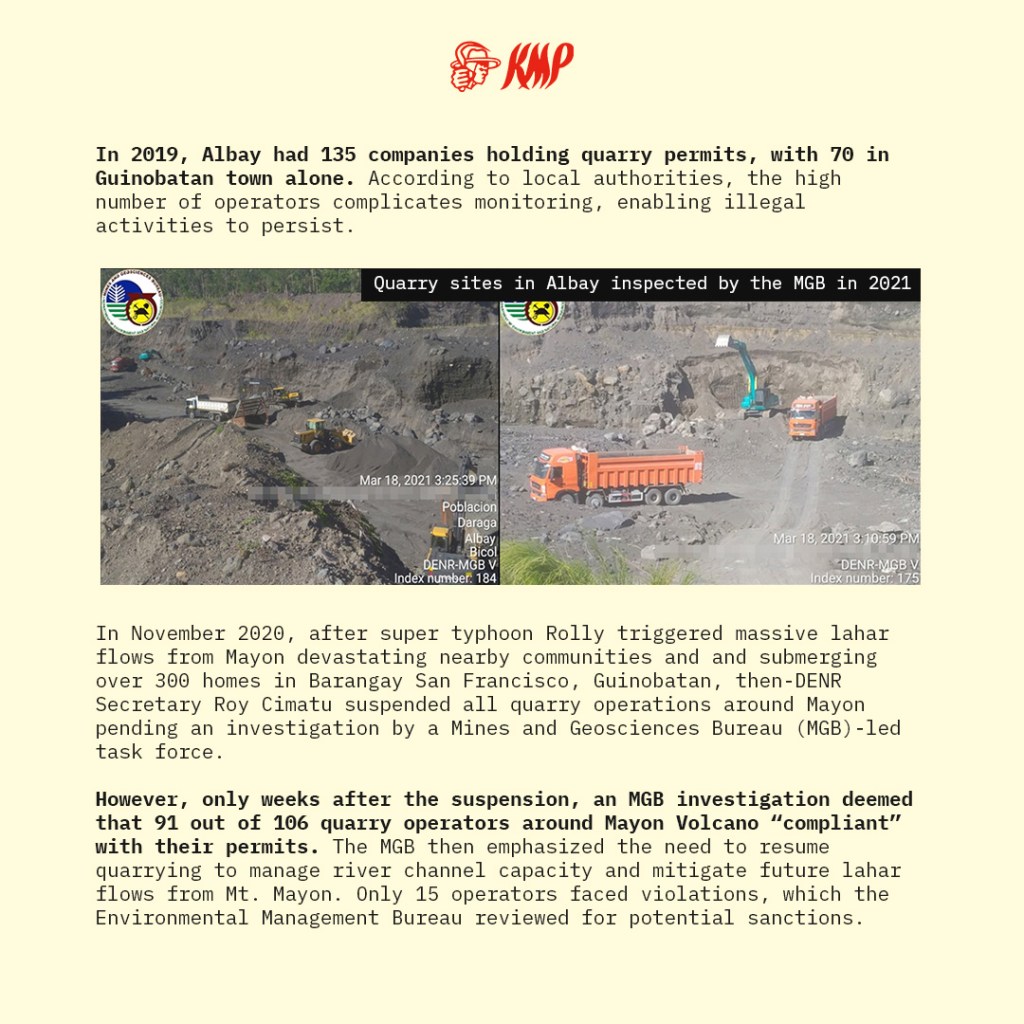
In 2019, Albay had 135 companies holding quarry permits, with 70 in Guinobatan town alone. According to local authorities, the high number of operators complicates monitoring, enabling illegal activities to persist.
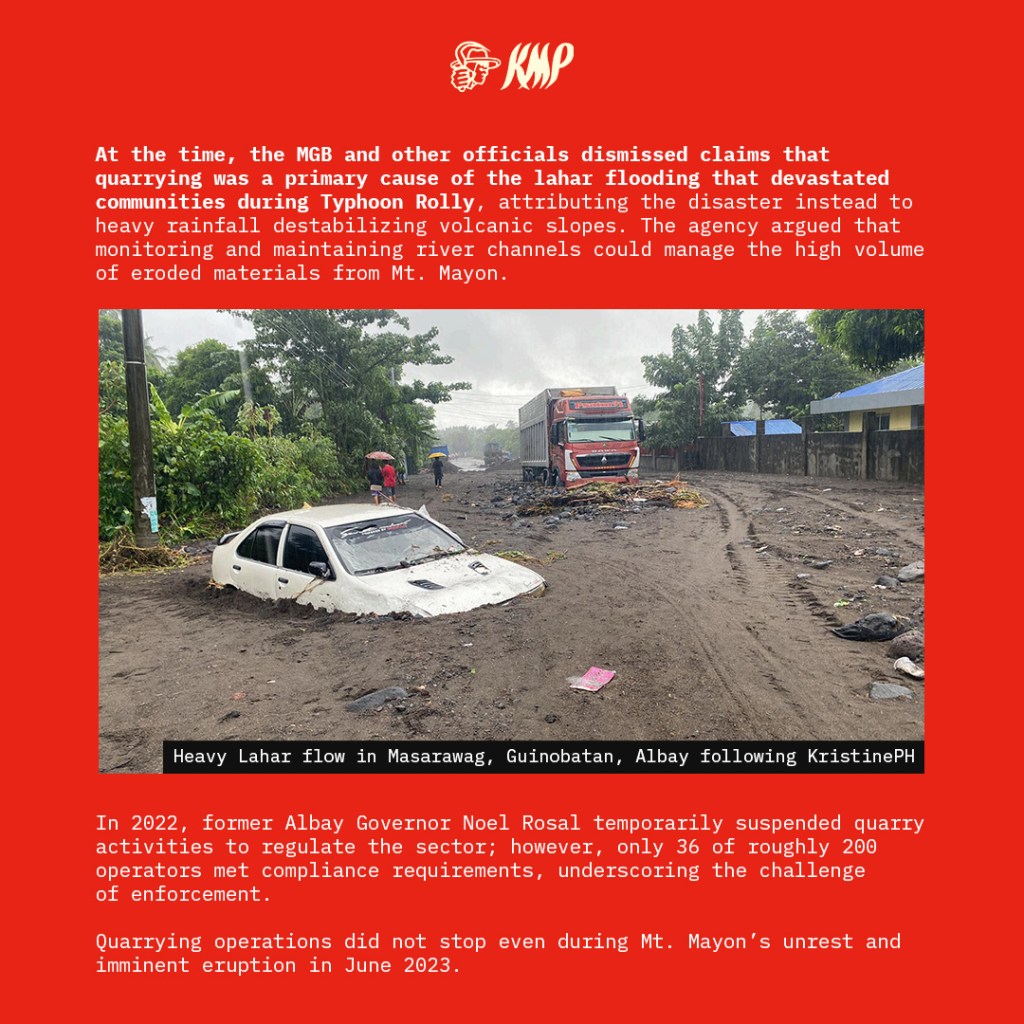
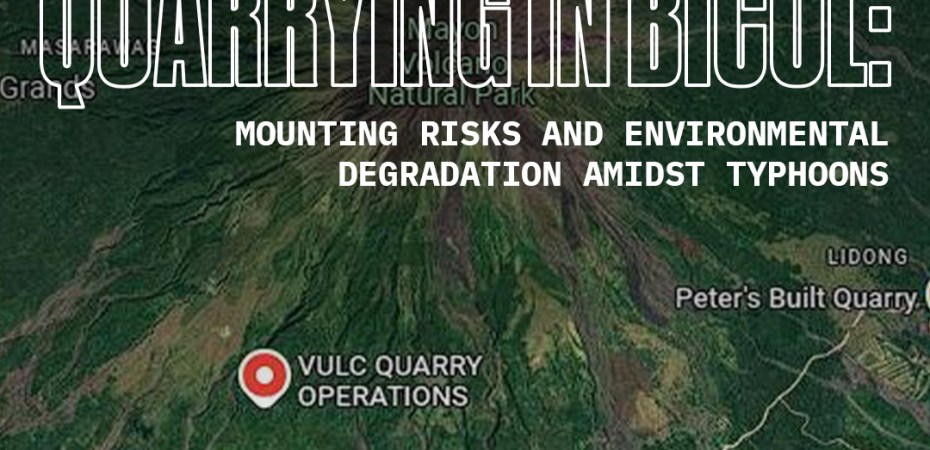
In November 2020, after super typhoon Rolly triggered massive lahar flows from Mayon devastating nearby communities and and submerging over 300 homes in Barangay San Francisco, Guinobatan, then-DENR Secretary Roy Cimatu suspended all quarry operations around Mayon pending an investigation by a Mines and Geosciences Bureau (MGB)-led task force.
However, only weeks after the suspension, an MGB investigation deemed that 91 out of 106 quarry operators around Mayon Volcano “compliant” with their permits. The MGB then emphasized the need to resume quarrying to manage river channel capacity and mitigate future lahar flows from Mt. Mayon. Only 15 operators faced violations, which the Environmental Management Bureau reviewed for potential sanctions.
At the time, the MGB and other officials dismissed claims that quarrying was a primary cause of the lahar flooding that devastated communities during Typhoon Rolly, attributing the disaster instead to heavy rainfall destabilizing volcanic slopes. The agency argued that monitoring and maintaining river channels could manage the high volume of eroded materials from Mt. Mayon.
In 2022, former Albay Governor Noel Rosal temporarily suspended quarry activities to regulate the sector; however, only 36 of roughly 200 operators met compliance requirements, underscoring the challenge of enforcement.
Quarrying operations did not stop even during Mt. Mayon’s unrest and imminent eruption in June 2023.
Political clout and environmental exploitation: The Villafuerte dynasty and quarrying in Camarines Sur
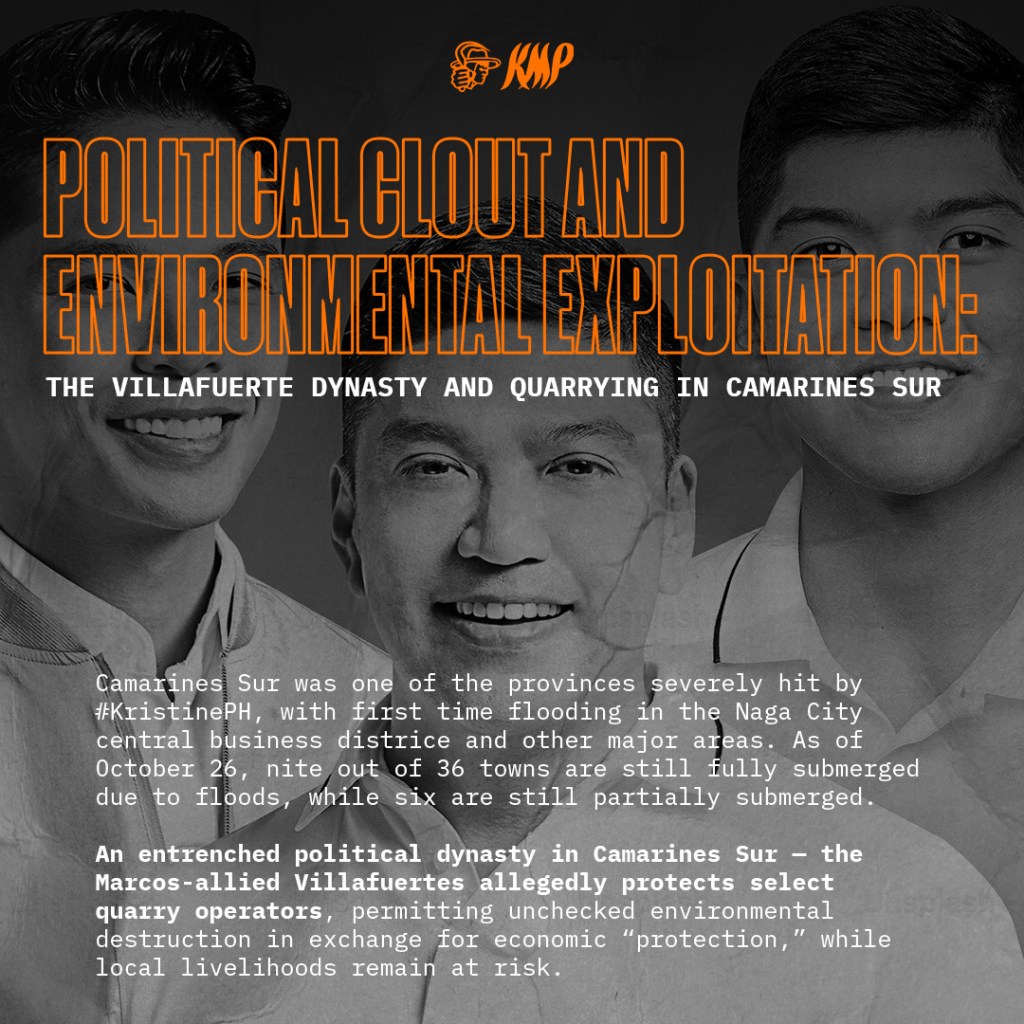
Camarines Sur was one of the provinces severely hit by #KristinePH, with first time flooding in the Naga City central business district and other major areas. As of October 26, nite out of 36 towns are still fully submerged due to floods, while six are still partially submerged.
An entrenched political dynasty in Camarines Sur — the Marcos-allied Villafuertes allegedly protects select quarry operators, permitting unchecked
environmental destruction in exchange for economic “protection,” while local livelihoods remain at risk.
In 2018, the late Goa Mayor Marcel Pan called for an investigation into extensive quarrying activities, citing environmental damage and harm to local communities. Pan implicated his predecessor, former Goa Mayor Antero Lim, as well as specific political figures and task forces, in shielding certain quarry operators from penalties. He also accused the Villafuertes of accepting protection money from unauthorized quarry operations.
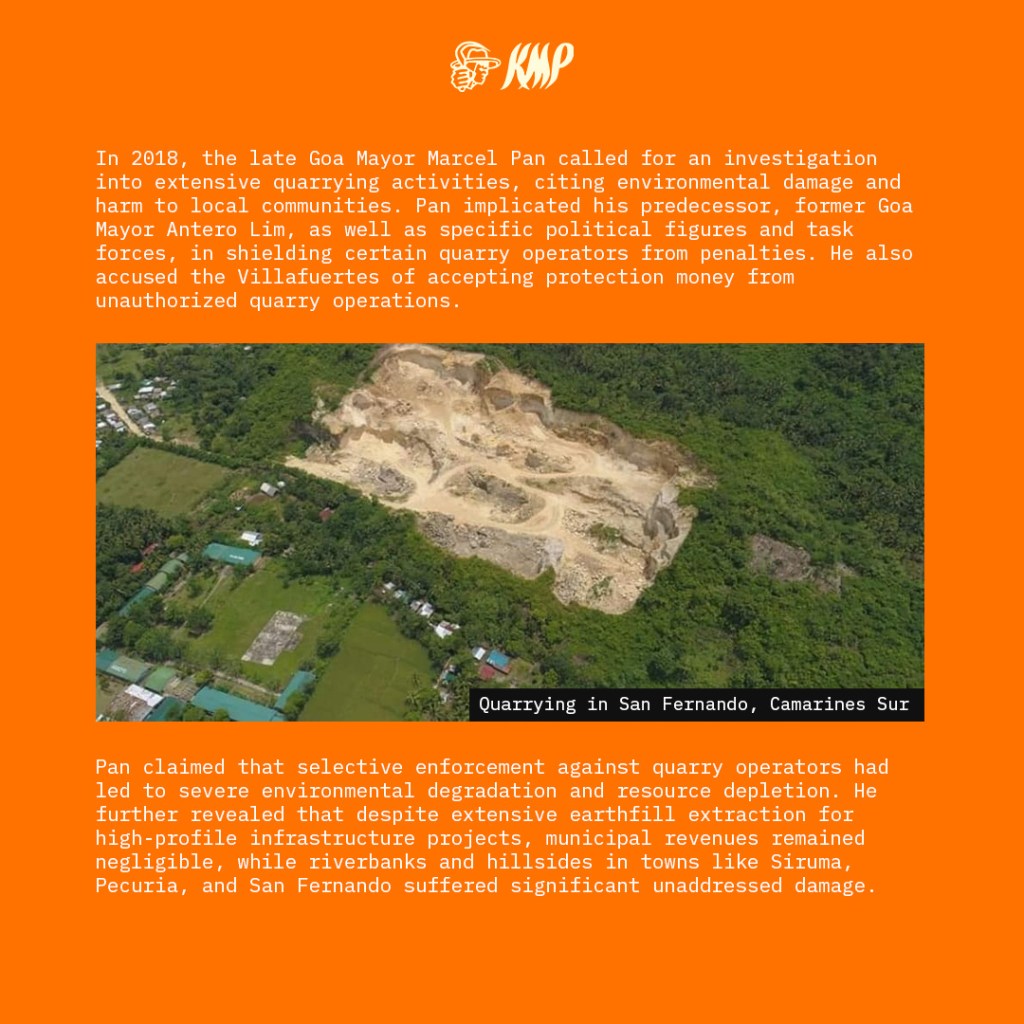
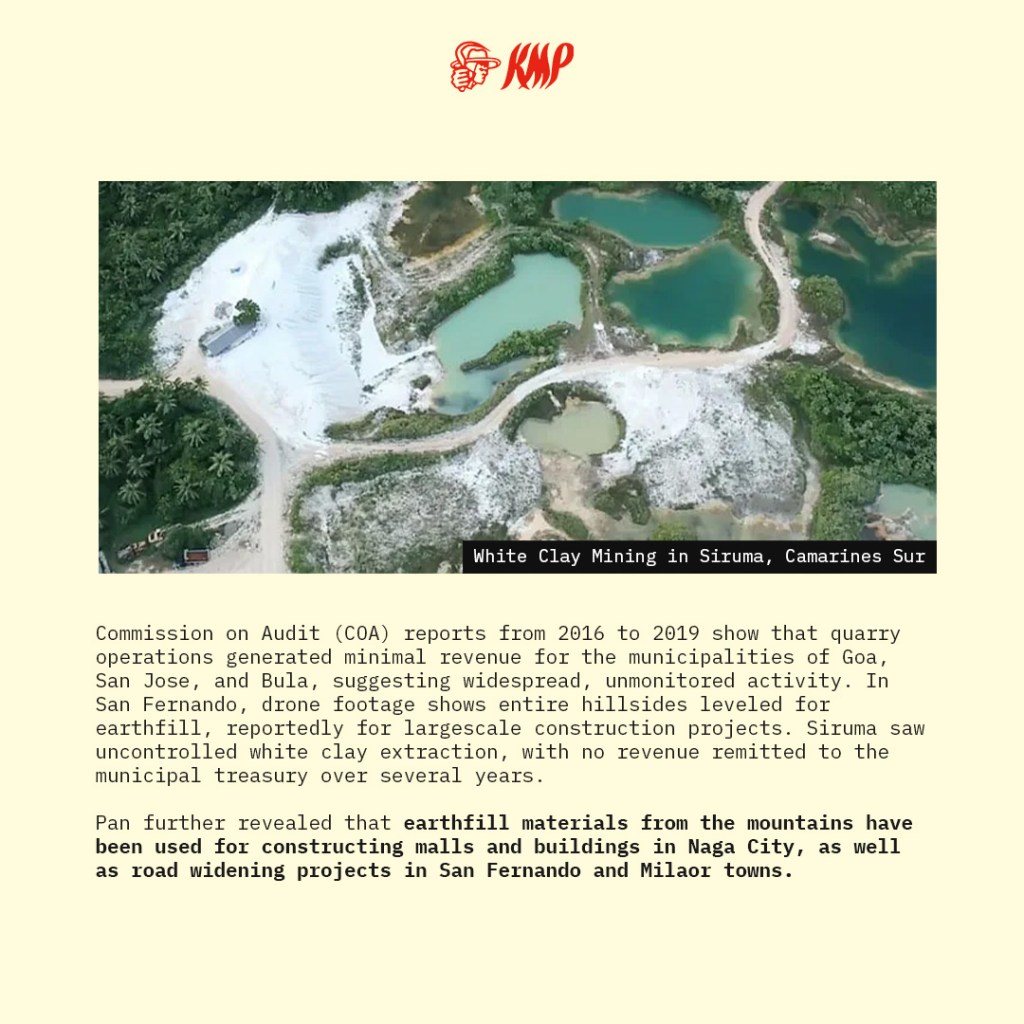
Pan claimed that selective enforcement against quarry operators had led to severe environmental degradation and resource depletion. He further revealed that despite extensive earthfill extraction for high-profile infrastructure projects, municipal revenues remained negligible, while riverbanks and hillsides in towns like Siruma, Pecuria, and San Fernando suffered significant unaddressed damage.
Commission on Audit (COA) reports from 2016 to 2019 show that quarry operations generated minimal revenue for the municipalities of Goa, San Jose, and Bula, suggesting widespread, unmonitored activity. In San Fernando, drone footage shows entire hillsides leveled for earthfill, reportedly for large scale construction projects. Siruma saw uncontrolled white clay extraction, with no revenue remitted to the municipal treasury over several years.
Pan further revealed that earthfill materials from the mountains have been used for constructing malls and buildings in Naga City, as well as road widening projects in San Fernando and Milaor towns.
His exposés on quarrying led to reprisals from the Villafuerte dynasty. In 2021, the Sagip Kalikasan Task Force (SKTF) in the province sought approval from the Sangguniang Panlalawigan to file criminal and administrative charges against Pan for alleged illegal quarrying activities and issuing threats to SKTF members.
The prolonged publicized disputes between Pan and former Camarines Sur Governor Migz Villafuerte have drawn attention to local government complicity and the effectiveness of the SKTF. The so-called environmental protection task force was established by Villafuerte patriarch Luis Villafuerte Sr., who held various positions in the Camarines Sur LGU from 1995 to 2013.
Urgent demands: Halting destructive quarrying and ensuring environmental accountability
With Bicol and the rest of the country increasingly exposed to severe typhoons and vulnerable to climate disasters, local and national groups are demanding a halt on destructive quarrying and the implementation of alternative livelihood programs to safeguard both the people and the environment.
While the MGB and DENR advocate for regulated quarrying to protect communities from lahar flows, ineffective enforcement and selective penalties enable large-scale environmental degradation. Environmental groups assert that LGUs and DENR permits contribute to environmental degradation, which intensifies the impacts of storms, resulting in preventable losses of life and livelihood. #
 updates from the peasant movement of the Philippines