
KMP condemns state’s failure in climate resilience and disaster preparedness
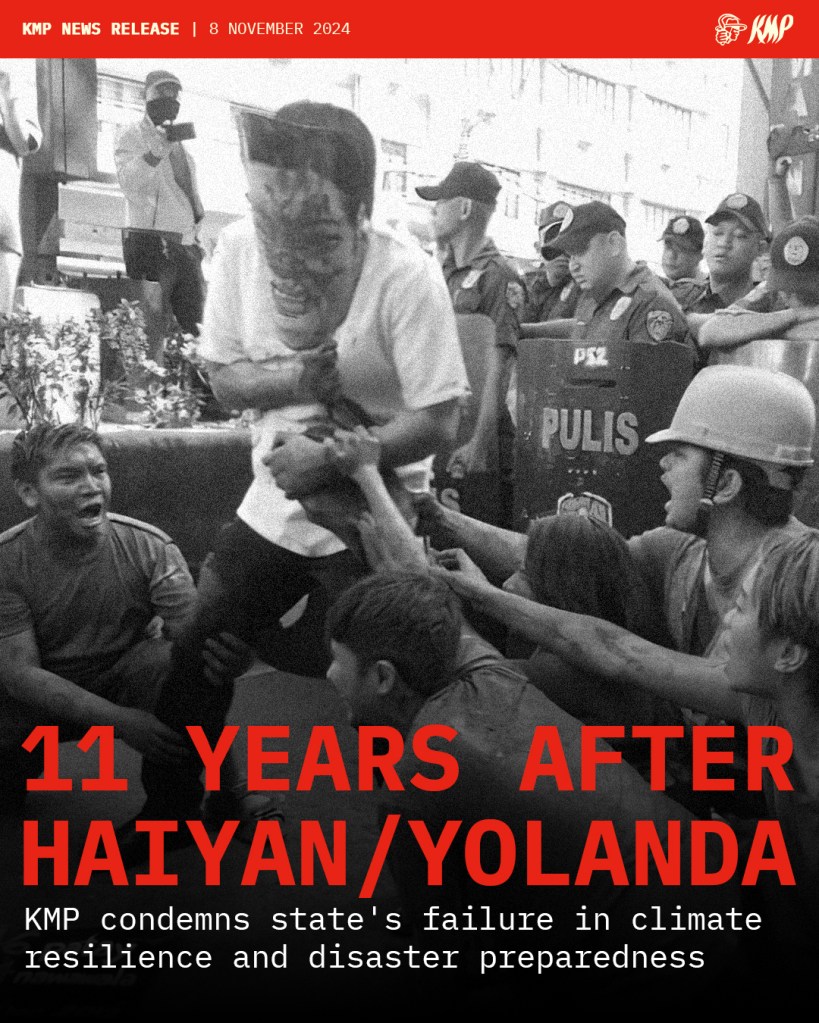
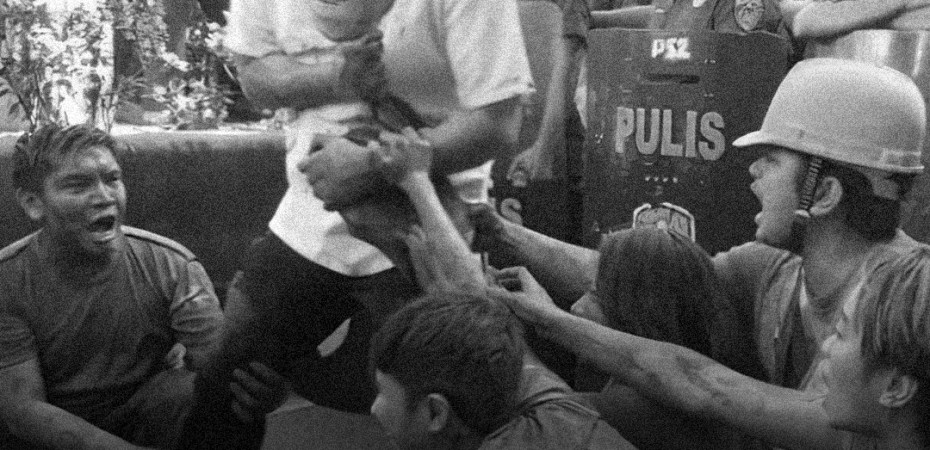
On the 11th year commemoration of super typhoon Haiyan (Yolanda), the Kilusang Magbubukid ng Pilipinas (KMP) and multisectoral groups protested near Mendiola in Manila this morning to denounce the PH government’s accountability in worsening the climate crisis and its failure in climate resilience and disaster preparedness. Regarded as the worst typhoon to hit the Philippines, the category 5 Haiyan killed more than 6,000 in Tacloban City and Leyte and left millions homeless due to massive storm surges.
“Instead of genuine disaster response and protection, the Marcos administration has only exacerbated vulnerabilities through ecologically destructive projects. Megadams, plantations, and indiscriminate land-use conversion are just a few examples of projects that have further deteriorated the environment and deepened the climate crisis. These projects underscore the persistence of semi-colonial and semi-feudal exploitation in the country, leaving Filipinos, particularly rural communities and farmers, at the mercy of climate-induced calamities without significant state support,” according to Danilo Ramos, chairperson of KMP and a Makabayan Senatorial candidate.
“Even with billions allocated to disaster risk reduction and management (DRRM), only half of these funds were utilized, leaving communities, particularly farmers and rural poor, unsupported and unprotected. The peasant group calls on the government to abandon its tokenistic disaster measures and invest in genuine support systems that will protect and uplift Filipino communities in the face of calamities.”
As exposed by the Commission on Audit (COA), in 2022 alone, the government allocated Php138.4 billion for DRRM, yet only 52% was utilized, despite a year marked by several major typhoons that left extensive damage across the country. “This highlights the hollow promises of the so-called civil defense efforts, leaving farmers and the rural poor to bear the brunt of climate-induced crises,” according to Ramos.
Low utilization of DRRM funds
Local Government Units (LGUs) across the country have alarmingly low utilization rates for their Disaster Risk Reduction and Management Funds (LDRRMF), with 218 LGUs using only one to 74% of their allocated funds. This underutilization persists despite the urgent needs of communities affected by disasters, livelihood destruction, debt, and poverty. Similar to the national government, LGUs are plagued by mismanagement, lack of documentation, delayed or failed projects, inadequate DRRM personnel, unresolved fund allocation issues, unused cash donations, and untransferred Quick Response Funds (QRF). The Philippine Statistics Authority (PSA) reports that, from 2015 to 2022, the total budget for DRRM reached P2.018 trillion, yet significant irregularities and inefficiencies remain.
KMP said that despite having a multitude of frameworks and laws—such as the Climate Change Act, the Philippine DRRM Act, and the People’s Survival Fund—the government’s DRRM programs remain riddled with irregularities, failed implementation, and “tokenistic support.” The COA findings reveal alarming issues, from unspent funds, failed relief distribution, and irregular procurement processes, to incomplete documentation, all of which have prevented vital aid from reaching affected communities. This corruption, coupled with the lack of local government utilization of the DRRM funds, worsens the suffering of farmers and rural communities who are consistently left behind after disasters,” according to KMP’s Ramos. The group demands a thorough audit and public accountability for every peso that was not delivered to the people.
“Genuine disaster preparedness and response must prioritize the welfare of the most vulnerable sectors, with programs directly benefitting those on the frontlines of climate impacts—our farmers, fisherfolk, and rural poor. Global initiatives like the Sendai Framework and the Sustainable Development Goals (SDGs) underscore the role of the State in reducing disaster risks, protecting citizens, and ensuring sustainable development. Yet, the Marcos’ administration’s civil defense and disaster response efforts are mere facades, failing to translate these principles into action for the people,” the group stated. ###
 updates from the peasant movement of the Philippines