
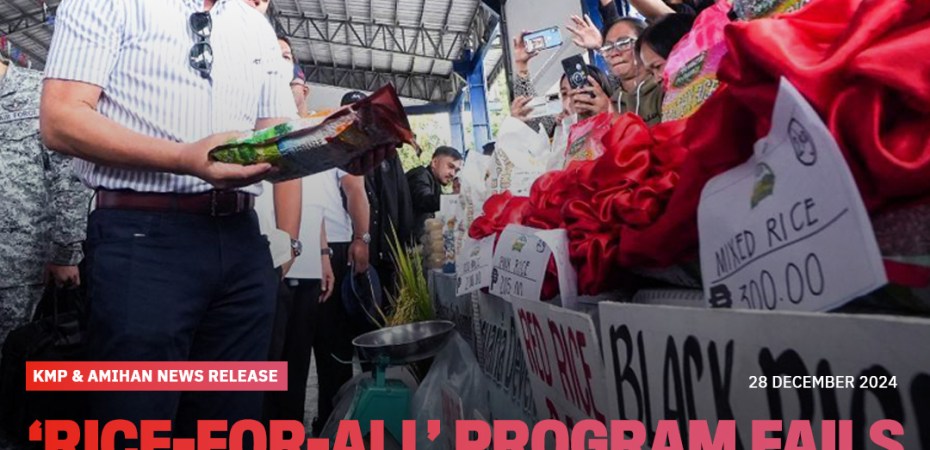
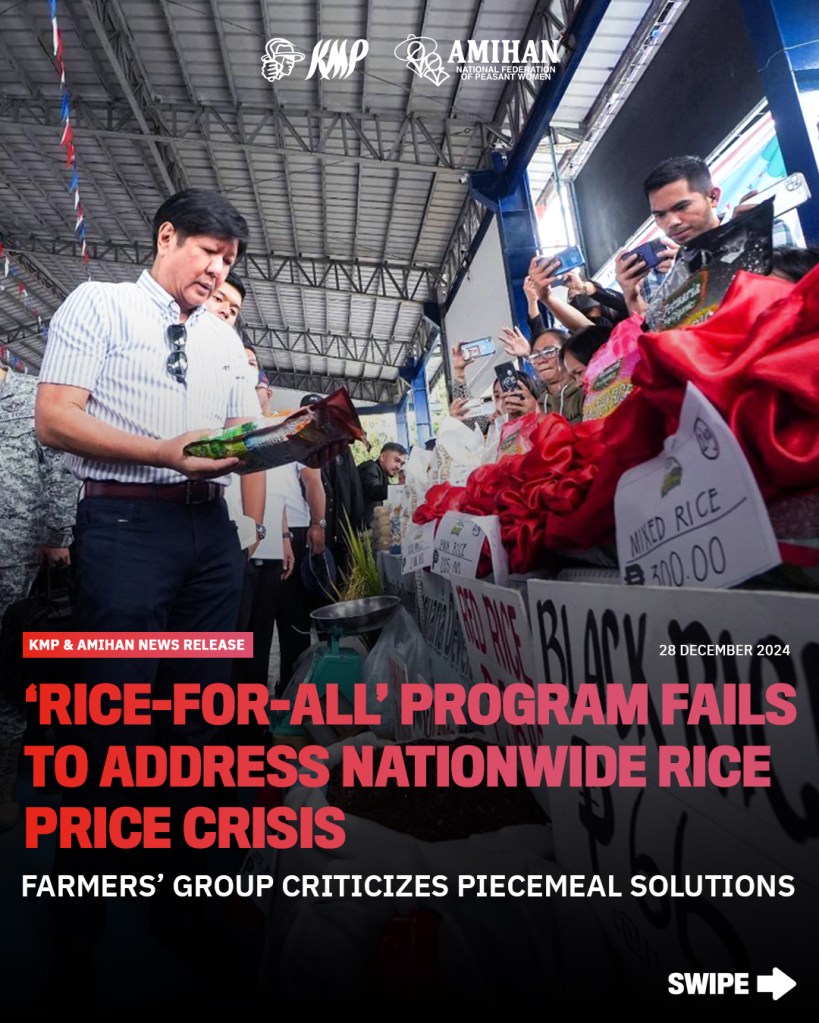
The Kilusang Magbubukid ng Pilipinas (KMP) and Amihan National Federation of Peasant Women (AMIHAN) today criticized anew the Department of Agriculture’s (DA) much-touted “Rice-for-All” program, calling it a stopgap measure that fails to address the roots of chronic high rice prices and the worsening plight of farmers and consumers nationwide.
The “Rice-for-All” initiative, implemented under the Kadiwa ng Pangulo program, has been touted by the government as a “success” in lowering rice prices in select areas in Metro Manila. However, the farmers’ groups pointed out that the program merely masks deeper issues of rice supply instability, import dependency, and the chronic neglect of local rice farmers.
KMP was quick to point out the DA’s misleading claims of price reduction
The government’s claim of reducing rice prices by Php3 to Php5 per kilo of rice in select public markets is hardly a triumph, given the limited reach of the program. In fact, distributing a few hundred sacks of rice in major urban centers barely scratches the surface of the rice affordability crisis experienced nationwide. For rural households and farmers, whose incomes remain stagnant, the minimal price reduction is negligble.
“The ‘Rice-for-All’ program is nothing more than a desperate populist showcase,” says Danilo “Ka Daning” Ramos for Senator, chairperson of KMP and a Makabayan senatorial candidate. “It temporarily forces down rice prices in urban centers but fails to provide long-term solutions to the worsening rice crisis. At the production side, farmers continue to grapple with high production costs, low farmgate prices, and exploitative practices from traders and middlemen.”
Amihan Women, for its part, acknowledged the importance of making rice affordable for urban poor communities but underscored the program’s glaring neglect of rural areas where the country’s rice is produced. “While urban consumers, especially workers and urban poor deserve relief through lower rice prices, the program is limited in selected areas of Metro Manila. Farmers in rural areas who grow the rice see no direct support or subsidies from this initiative,” the farmers’ group emphasized.
Despite the government’s Php5 billion allocation for the Rice-for-All program, farmers remain burdened by exorbitant costs for seeds, fertilizers, and post-harvest procesess. The contract farming touted by the National Irrigation Administration (NIA), is not yet proven as a viable model for lowering rice prices, with only a fraction of its yield dedicated to the government’s target of Php29 per kilogram.
“The Marcos administration is quick to deploy temporary measures to appease urban consumers but neglects the long-term reforms needed to uplift farmers and stabilize the rice supply chain,” said Cathy Estavillo, spokesperson of Bantay Bigas and secretary-general of Amihan.
KMP also warned that the government’s reliance on rice importation underpins the Rice-for-All program, undermining local production. Imported rice floods the markets while palay farmgate prices plummet, leaving farmers with diminished incomes.
“Instead of expanding local rice production, the DA continues to lean on importation, which destabilizes the market and drives local farmers into heavy debts,” said Ramos. The group called for the immediate prioritization of policies that strengthen local rice production, such as protecting lands devoted to food production, providing production subsidies, and supporting post-harvest facilities.
The group reiterated its long-standing demand for genuine agrarian reform, which it argues is the only real and sustainable solution to the rice crisis. “Until farmers are guaranteed land ownership and control over production, these piecemeal programs will only perpetuate hunger and poverty among rural communities,” Ramos said.
Our call remains steadfast: repeal the Rice Liberalization Law and restore the National Food Authority’s regulatory powers to enable the fair purchase of local palay and ensure affordable rice in markets. We must unite to prioritize the development of local production over imports, securing benefits for the entire nation, achieving food security, and attaining rice self-sufficiency,” Estavillo emphasized. “The government’s rice programs are nothing more than band-aid solutions to a deep wound inflicted by decades of neoliberal agricultural policies,” the Gabriela Women’s Party 2nd nominee added.
KMP and Amihan challenged the DA and the Marcos administration to abandon ineffective and temporary measures. “We have repeatedly proposed actionable measures to address the rice crisis:”
1. Enacting genuine agrarian reform to ensure land ownership and productivity for farmers.
2. Halting large-scale importation that depresses local market prices.
3. Increasing budget allocation for production subsidies to support local farmers.
4. Providing price guarantees for farmers to ensure fair palay farmgate prices.
“The solution to the rice crisis lies not in grandstanding programs but in empowering farmers who are the backbone of our food security,” Ramos concluded. ###
 updates from the peasant movement of the Philippines