
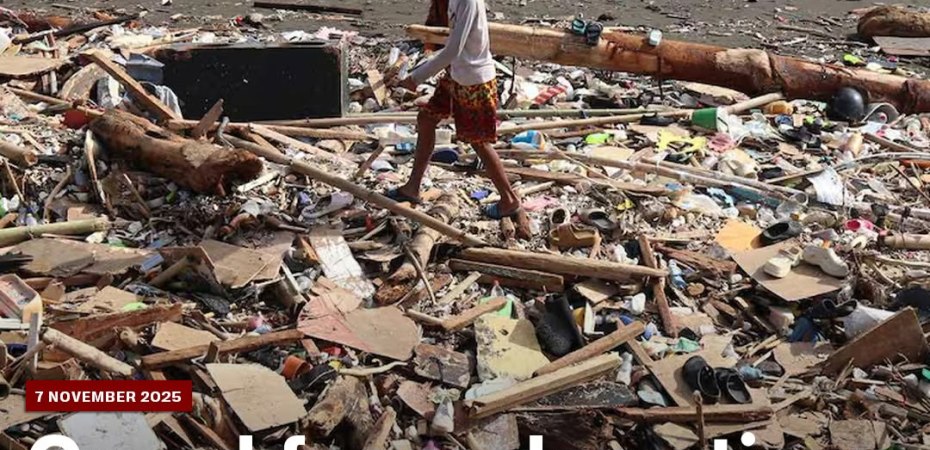
The Kilusang Magbubukid ng Pilipinas (KMP) said that the devastation caused by Typhoon Tino (international name Kalmaegi) across the Visayas reveals how the government’s obsession with reclamation and “profit-driven development” is destroying natural coastal barriers and worsening the impacts of disasters.
According to the National Disaster Risk Reduction and Management Council (NDRRMC), 188 have have died while hundreds of thousands were displaced as Typhoon Tino swept through Central and Eastern Visayas and parts of Mindanao. It caused unprecedented flooding, landslides, and heavy damage to infrastructure in Cebu. Houses, properties, and livelihood have been washed away. Losses will take months, and even years, for typhoon survivors to recover from.
“The destruction that we see in Cebu is not only because of the typhoon. Super Typhoon Yolanda in 2013 taught us what neglect and corruption can do. Typhoon Tino reminds us that nothing has changed,” said KMP chairperson Danilo Ramos. “Kapag ginawang negosyo ang mga bundok at baybayin at pinatag ang mga bakawan para sa reklamasyon, sinasalanta na rin ang mga komunidad na dapat protektahan.”
KMP pointed out that in recent years, the Visayas has become a hotspot for massive reclamation and coastal conversion projects that alter tidal flow and destroy mangrove forests. Cebu and Lapu-Lapu cities have at least a dozen proposed reclamation projects covering more than 1,000 hectares, including the controversial 235-hectare Cebu City Waterfront Reclamation Project. In Iloilo, the 662-hectare Iloilo Global City reclamation project that was endorsed for evaluation by the Philippine Reclamation Authority (PRA). In Negros Occidental, similar proposals for Bacolod City’s coastal expansion are under review by the Department of Environment and Natural Resources (DENR) and PRA.
In Cebu, the massive reclamation along Lapu-Lapu, Consolacion, and Mandaue stripped away mangroves and natural buffers, leaving coastal and drainage systems severely weakened. When Typhoon Tino struck, floodwaters rose faster, rivers overflowed, and entire low-lying barangays were engulfed, prompting the city to review its flood control projects.
Reclamation in Cebu has expanded at an alarming pace. The Supreme Court recently gave the go-signal to the 131-hectare Global City Mandaue project, paving the way for major construction along the Mactan Channel. Cebu City’s South Road Properties now covers around 300 hectares, while the North Reclamation Area adds another 170 hectares.
In 2024, the Cebu Provincial Reclamation Authority under former Governor Gwendolyn Garcia approved six more projects in Toledo, Balamban, Carmen, Compostela, Dumanjug, and Oslob. Before that, Garcia also green lighted reclamations of the Cebu South Harbor Container Terminal Corporation in Talisay City, Cebu South Harbor in Minglanilla town, Cebu Industrial Park Developers in west Cebu’s Balamban town, and Dynacast in the northern city of Danao. Combined with other proposed sites, reclamation in Cebu now spans roughly 765 hectares that encroaches on municipal waters and wiping out mangrove forests that once protected coastal communities from floods and storm surges.
Under the Duterte and Marcos administrations, reclamation projects surged nationwide with over 90 proposals covering more than 30,000 hectares were endorsed or revived, reflecting an aggressive push for coastal conversion driven by real estate, tourism, and infrastructure interests despite widespread environmental and fisherfolk opposition.
These projects, according to KMP, have replaced mangrove belts and wetlands that once absorbed storm surges and reduced flooding. “Ang mga bakawan at dalampasigan ay natural na depensa laban sa malalakas na alon at bagyo,” said Ronnie Manalo, KMP secretary general. “Ngayon, puro semento at imprastraktura na ang nakaharang sa daluyan ng tubig. Kapag dumating ang bagyo, diretso na ang pinsala sa mga komunidad.”
KMP said that reclamation activities have disrupted natural drainage systems and increased coastal erosion. The group also cited the DENR’s own environmental impact assessments classifying reclamation as environmentally critical projects, yet local governments continue to approve them for the sake of tourism and real estate investments.
KMP urged the Marcos Jr. administration to declare a moratorium on all reclamation projects in high-risk coastal areas and to direct the DENR and PRA to conduct an independent, transparent review of all existing reclamation and dredging permits in the Visayas.
“Mauulit lang ang epekto ng sakuna kung patuloy ang reklamasyon, quarrying, destructive mining at iba pang mapaminsalang proyekto,” Manalo said. “Hangga’t pinapayagan ng gobyerno ang mga proyekto na sumisira sa likas na depensa ng kalikasan, mas magiging nakakamatay ang bawat bagyo. Kapalit ng mga tinaguriang ‘development’ at kita para sa mga negosyo ay buhay at kabuhayan ng mamamayan.”
KMP said typhoon survivors must unite and demand for a people-led recovery program focused on rebuilding livelihoods and ensuring protection for the most vulnerable communities and sectors.

