
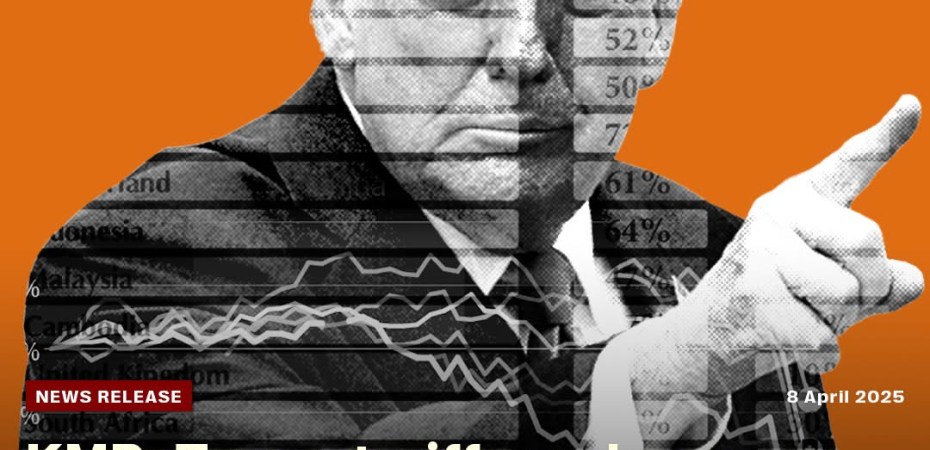
The Kilusang Magbubukid ng Pilipinas (KMP) today slammed the Marcos Jr. administration’s continued economic dependence on foreign powers in light of a new wave of protectionist tariffs announced by former U.S. President Donald Trump, calling it a “wake-up call” and a stark reminder of the failures of neoliberal globalization.
“Trump’s tariffs are a wake-up call,” said KMP Chairperson Danilo Ramos. “This is the cost of surrendering our economy to foreign interests. While the U.S. is moving to protect its economy, the Marcos Jr. regime continues to serve foreign dictates — slashing tariffs, begging for crumbs, and giving away our national assets piece by piece.”
The new U.S. tariffs are seen as a blow to the global trade order — but according to KMP, they only reveal what Filipino farmers and workers have long known: that so-called “free trade” has only benefited the few while destroying local industries and livelihoods.
“For decades, we were told to open up and let foreign capital in. What did we get in return? Collapsed industries, decimated agriculture, and millions of workers sent abroad like export products,” said KMP Secretary General Ronnie Manalo. “Let us call it what it is: betrayal. The government is not protecting Filipinos — it is protecting foreign capital and the local elite.”
The farmers’ group criticized the Marcos Jr. administration’s recent decision to further lower tariffs on imported goods, even as other countries turn inward. “While the world moves toward protectionism, our leaders are making the Philippines more vulnerable, more dependent, and less capable of standing on its own,” Manalo added.
KMP said the Philippines never truly benefitted from U.S.-led globalization. Instead, it left the country without a solid industrial base or food security. “When the U.S. dropped tariffs before, it did not help us — because we had nothing left to export. What globalization did was dismantle our capacity to produce. We didn’t just send goods abroad, we exported people,” Ramos said.
The impact of rising global protectionism will hit hardest the poorest Filipinos — the 18 to 20 million families who rely on cheap imports due to the government’s failure to develop domestic industries. With the cost of food, fuel, and other essentials expected to rise, KMP warned that the crisis will only intensify.
The group also rejected any pivot toward China as an alternative power. “Shifting dependency from the U.S. to China changes nothing. Dependency is still dependency. Exploitation is still exploitation — no matter who is in charge,” Manalo said.
KMP is calling for a radical shift in economic direction, anchored on genuine land reform and national industrialization. “Enough with the export-oriented, import-dependent economy. We need Filipino farms, Filipino factories, and Filipino futures,” Ramos said. “That means land for tillers, real food security, and State-led industrial growth. Not another cent for oligarchs or foreign profiteers.”
“This is not just a crisis — it is a moment of reckoning,” Ramos emphasized. “We must bury neoliberalism and fight for a truly independent national economy. The time to act is now.”
As the May 2025 elections draw near, KMP urged the public to reject traditional politicians and technocrats who upheld failed economic policies. “Let us elect leaders who will champion economic sovereignty and the rights of the Filipino masses,” the group concluded. ###

