
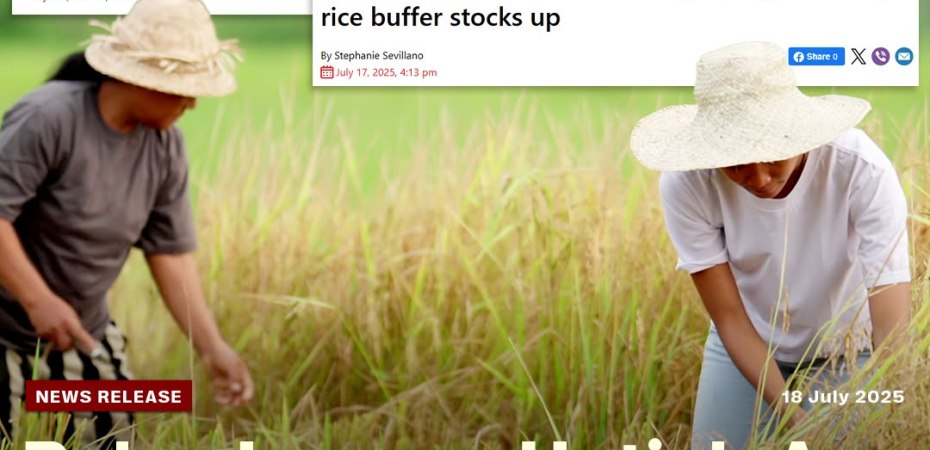
The Kilusang Magbubukid ng Pilipinas clarifies on the Philippine Statistics Authority’s (PSA) claim that Filipino rice farmers earned more in 2024 despite increased palay production costs. This rosy picture collapses under scrutiny, revealing a worsening agrarian crisis buried beneath statistical averages. While gross receipts may have ticked up nominally, actual net incomes and the sustainability of rice farming continue to deteriorate, especially under the Marcos Jr regime’s neoliberal policies and rice import dependence.
In a study done by KMP, a typical Bulacan rice farmer in 2024 earned just P4,942 per hectare per season, or P1,647 per month, after deducting land rent, hauling, harvester fees, and interest on loans. That’s barely enough for subsistence—let alone reinvestment, debt repayment, or capital build-up.
This dismal figure is concealed in government statistics by focusing on gross production value without deducting costs. In reality, farmers absorbed massive input price increases. For instance, fertilizer costs (P10,200/ha) and harvesting fees (10% of total output) swallowed nearly 60% of total revenue, while land rent took 13 cavans—or over half the net harvest. Loan interest is also added to the burden. This is not to mention that in 2024, farmers were heavily assailed by multiple typhoons and other natural disasters such as El Niño that severely harmed local production.
Even worse, palay farmgate prices remained stagnant at around P16/KG, while rice import volumes reached a record 4.8 million MT in 2024, with a projected 5.4 million MT in 2025, making the Philippines the world’s top rice importer. These imports depress local palay prices and undercut farmers’ bargaining power, particularly as rice trade has become increasingly monopolized. In 2024, the top 10 importers controlled 40% of the total rice imports, up from 24% in 2019, while commercial traders held 56% of rice stock, up from 39% in 2022.
This minute rise from P0.47 for every kilo of palay in 2023, compared to the P0.63 in 2024, a measly P.014 increase, affirms the failure of the Rice Liberalization Law (RLL) or RA 11203. Before the RLL was enacted, in 2017 PSA cited an around P6.4 net profit per kilogram of palay, while in 2018 an around P8.6 per kilo. Despite the triumphant tone of recent headlines on rice farmer income, effects of the RLL reflect a profit gain of less than a quarter of a peso.
The Marcos Jr regime’s lowering of rice tariffs—from 35% to 15% via EO 62—meant more imported rice, less government revenue (P35 billion lost in 2024 alone), and no substantive reinvestment into local production. Palay production has remained stagnant at around 19 million MT since 2017 despite ballooning budgets under the Rice Competitiveness Enhancement Fund (RCEF). This points to ineffective or misallocated spending that has not directly improved farmer incomes.
“Labas pa sa mga pagsabotahe ng pamahalaan sa lokal na industriya ng bigas, sila rin ang nagpapatibay ng mga patakaran sa pagpapanatili ng kawalan ng lupa sa mga magsasaka. Katulad lamang ng mga pangangamkam ng lupa sa pamamagitan ng land use conversion, at tahasang kawalan ng tunay na reporma sa lupa, patuloy na mababaon ang mga magsasaka sa utang at sa pagsalo ng kalakhan na gastos sa produksyon” said KMP Chairperson Danilo “Ka Daning” Ramos.
Even if certain farmers temporarily reported higher earnings, this “growth” is not structural—it’s fragile, geographically uneven, and unsustainable. Input prices are volatile, climate risks rising, and government subsidy mechanisms remain inadequate. Meanwhile, most farmers are still buried in debt and unable to save.
“Hindi totoo na umaangat ang kabuhayan ng mga magsasaka. Habang lumulubog ang presyo ng palay at tumataas ang gastos sa produksyon, walang pakinabang ang dagdag-kitang wala pang bentsingko sentimos. Walang tunay na pag-unlad sa estadong pabor sa importasyon.” Ramos added.
Come SONA 2025 where Marcos Jr. is expected to flaunt his “milestones” of “achieving” P20 rice, local rice production remains in shambles while rice remains to be not affordable for the general public. The “higher earnings” reported in 2024 are not a sign of rural upliftment, but rather a statistical mirage obscuring a deep and worsening agrarian crisis. Without genuine land reform, bolstering of the rice industry, and protection against exploitative imports, Filipino farmers will remain trapped in a cycle of poverty—regardless of what PSA aggregates and the Marcos Jr. administration claim. ###

