
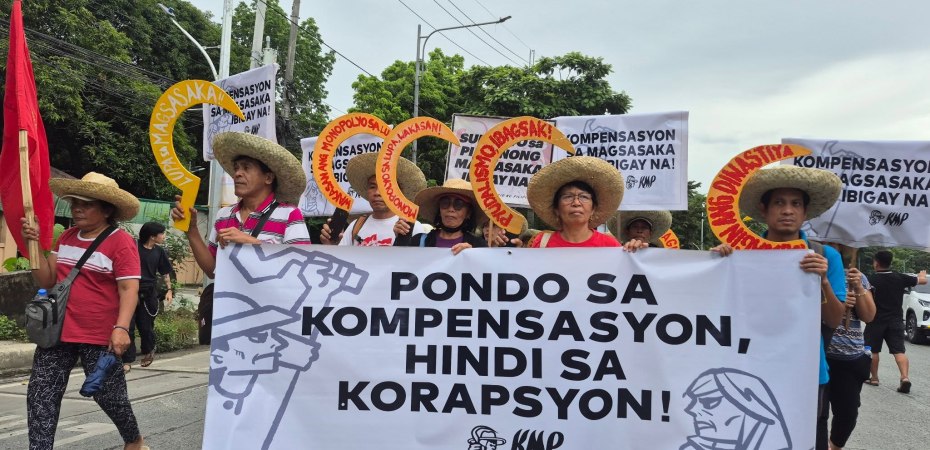
Farmers from Negros Occidental are leading this year’s World Hunger Day commemoration in Metro Manila through the “Kampuhang Magbubukid para sa Lupa at Laban sa Korapsyon”: a protest camp set up in front of the Department of Agrarian Reform (DAR) Central Office in Quezon City.
Over 40 farmers from various towns and haciendas in Kabankalan, Cadiz, Murcia, Silay, Escalante, Pontevedra, and Candoni, Negros Occidental, have joined the camp. Among them are indigenous peoples displaced by the HAPI-Consunji oil palm plantation in Candoni, which covers thousands of hectares of ancestral and agricultural lands.
The Negros farmers and sugar workers traveled to Manila to demand immediate dialogues with DA, DAR, DENR, and CHR, and to denounce the decades-long failure of land reform programs, persistent harassment, and continuing displacement under the bogus Comprehensive Agrarian Reform Program (CARP) and the Support to Parcelization of Land for Individual Titles (SPLIT) program jointly implemented by DAR and the World Bank.
In Negros Island, often referred to as the country’s “hacienda capital”, rampant land reclassification turns agrarian reform lands into commercial, residential, or energy project sites. The cancellation of Collective Land Ownership Awards (CLOAs) and the parcelization of collective land titles under SPLIT have further intensified land conversion and corporate control over farmlands.
The farmers also highlighted the slave-like wages and chronic hunger suffered by sugar workers in Negros, worsened every year by the Tiempo Muerto or dead season when sugar mills stop operations. Despite their grueling work, farmworkers only earn P82–P333 per day, far below the living wage. “While landlords and corrupt officials enrich themselves, those who till the land remain hungry,” said Danilo Ramos, KMP chairperson.
Amid worsening effects of climate disasters, Negros farmers are also demanding immediate and just compensation for the massive damages to their crops, homes, and livelihoods. Each year, typhoons, floods, and droughts destroy farmlands and livestock — yet farmers receive little to no support. Between 2010 and 2019, the agricultural sector absorbed over 62% of total disaster damages, amounting to P463 billion, while billions of pesos in disaster funds are lost to corruption and mismanagement.
Under Marcos Jr.’s neoliberal policies, Negros Island is being transformed into the country’s Renewable Energy capital. Massive projects such as AboitizPower’s Calatrava Solar Farm, Citicore Solar in Silay, and the Bacolod-Bago Solar Plant are set to occupy more than 1,100 hectares of former agricultural land, producing up to 1,000 MW of energy.
In Candoni, HAPI-Consunji is set to expand its oil palm plantation from 6,652 hectares to 12,000 hectares in five years. An International Solidarity Mission found direct evidence of land grabbing, environmental destruction, and threats of displacement against farmers and indigenous peoples.
The Kampuhang Magbubukid will culminate in a mass protest on October 21 at Liwasang Bonifacio, where various sectors will march together against corruption, landlessness, and oppression.
 updates from the peasant movement of the Philippines