
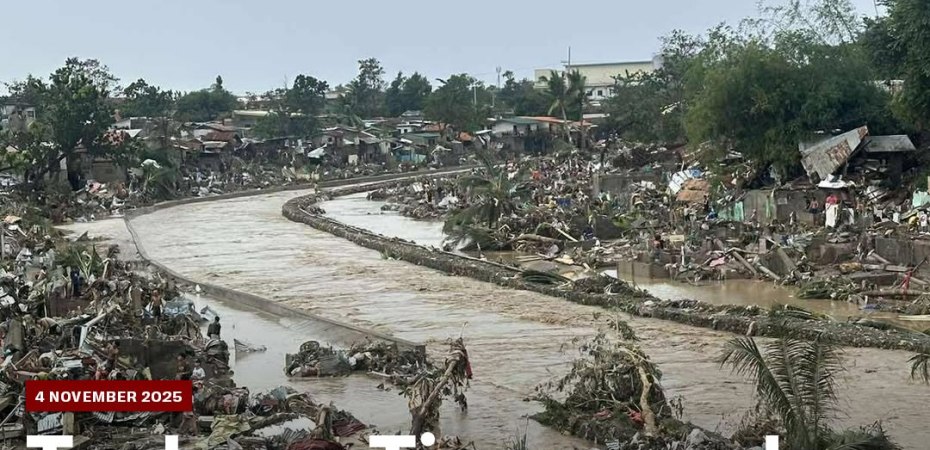
As Typhoon Tino (international name: Kalmaegi) pounded parts of Central Visayas and forced thousands of residents to evacuate, the Kilusang Magbubukid ng Pilipinas (KMP) warned that the storm has exposed the worsening consequences of widespread and unregulated quarrying across Cebu province.
According to the National Disaster Risk Reduction and Management Council (NDRRMC), Typhoon Tino has affected around 17,124 families or nearly 60,000 individuals across Central Visayas. In Cebu province alone, 1,382 families or 6,137 individuals from Cordova, San Francisco, Catmon, Danao City, Talisay City, and Tudela have been evacuated. Videos across social media showed many flooded areas in Metro Cebu and other towns.
“These impacts are not entirely caused by natural disasters but by decades of environmental degradation,” said Danilo Ramos, KMP chairperson. “Cebu is known for its destructive quarrying activities. The Cebu City Council also previously noted that “unabated” quarrying in upland barangays is causing flooding downstream. The devastation brought by Typhoon Tino is a grim reminder of the results of irresponsible and indiscriminate quarrying. We are witnessing a disaster worsened by plunder and government neglect.”
KMP said the latest disaster underscores how decades of quarry operations involving large-scale soil extraction, mountain cutting, and watershed degradation have left many communities highly vulnerable to landslides and flooding. These risks, the group added, have been aggravated by the typhoon’s heavy rainfall. PAGASA reported that Tino dumped 183 mm of rain or equivalent to almost a month and a half’s worth of rain in November.
Despite recent local government directives suspending quarry and earth-moving activities, quarrying remains widespread in Cebu. For years, quarry operations have been present in municipalities and cities such as Asturias, Balamban, Bogo City, Carcar City, Dalaguete, and Toledo City. Extracted materials include limestone, sand, and gravel used for construction. The province also hosts major cement producers such as Apo Cement, Taiheiyo Cement, Century Peak Cement, Mabuhay Filcement Inc., Republic Cement, and Eagle Cement.
In July, Cebu Governor Pamela Baricuatro imposed a one-month suspension on all quarry activities to allow a review of permits. Earlier this year, former Governor Gwendolyn Garcia also ordered the suspension of operations of Apo Land and Quarry Corporation (ALQC) and Solid Earth Development Corporation. Over the years, the provincial government has issued several cease-and-desist orders, suspensions, and moratoriums due to violations such as operations outside designated areas, and environmental and safety concerns. However, quarrying remains a significant economic activity.
KMP said large-scale quarrying operators in Cebu should be held liable and implement long-term rehabilitation measures to restore watersheds and protect communities. The group also urged the national government to consider a ban on destructive quarrying and prioritize community-led rehabilitation programs.

