
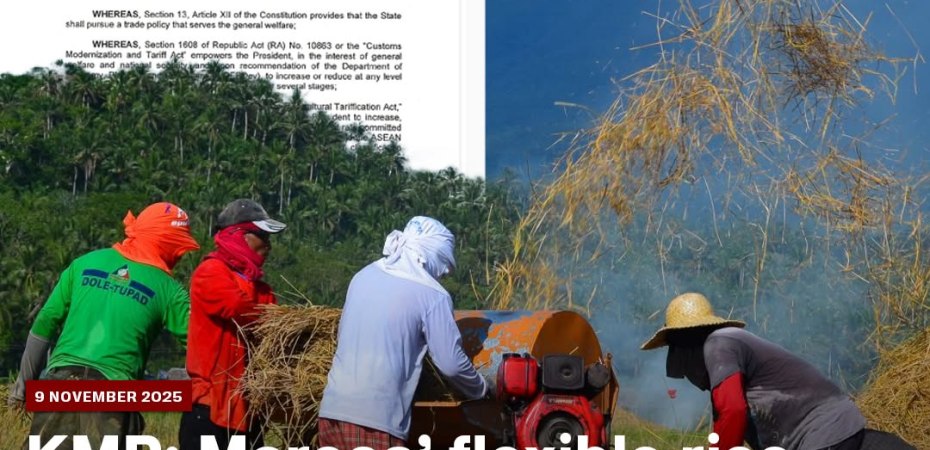
The Kilusang Magbubukid ng Pilipinas (KMP) denounced President Marcos Jr.’s new Executive Order 105 to implement a “flexible rice tariff adjustment” starting January 2026, calling it another neoliberal policy that will further liberalize the rice industry and abandon Filipino rice farmers. The latest EO amends EO 62.
Under the order, the Most Favored Nation (MFN) tariffs on rice will rise by five percentage points for every five percent drop in global rice prices, or fall by five percentage points for every five percent increase, within a range of 15% to 35%. The policy will be managed by an Inter-Agency Group on Rice Tariff Adjustment composed of the Department of Economic Planning and Development (DEPDev), Department of Agriculture (DA), Department of Trade and Industry (DTI), Department of Finance (DOF), and the Office of the Special Assistant to the President for Investment and Economic Affairs.
KMP Chairperson Danilo Ramos said the measure is “a recycled experiment meant to hide the failure of the Rice Liberalization Law (RA 11203),” which has already devastated local rice production and deepened the country’s dependence on imports.
“Pinalalabas ng gobyerno na flexible tariff ang solusyon, pero ang totoo, palusot ito para ipako ang bansa sa import dependency. Sa bawat pagbaba ng taripa, mas nalulugi ang mga magsasaka,” Ramos said.
Since the law’s implementation in 2019, rice imports have reached over 3 million metric tons annually while palay prices have remained depressed and production costs have risen. Farmers have been forced to sell at a loss while traders and importers profit from cheap imported rice.
KMP warned that the new scheme will flood the market with cheap rice when world prices drop, wiping out local farmers, while higher tariffs when global prices rise will not benefit them because of the chronic neglect of domestic production. “Makikita rin na wala talagang epekto ang import ban,” Ramos stressed.
KMP Secretary-General Ronnie Manalo criticised the creation of the Inter-Agency Group, calling it “a technocratic smokescreen to legitimize corporate and importer control over rice policy.”
“Hindi konsultado ang mga magsasaka. Ang dapat gawin ay hindi flexible tariff kundi total repeal ng Rice Liberalization Law at pagbabalik ng NFA sa tungkulin nito sa regulasyon at pamimili ng palay,” Manalo said.
The peasant group stressed that tariff adjustments will not stabilize rice prices but will instead secure the profits of importers and traders.
“Ang panawagan ng mga magssaka suportahan ang lokal na produksyon at hindi ang mga importer. Ang kailangan ng mga magsasaka ay sapat na presyo, subsidyo, at suporta sa pagsasaka, hindi pagtaas-baba ng taripa na pabor sa merkado,” Manalo said.
KMP reiterated that as long as the Rice Liberalization Law remains in place, farmers and consumers will stay vulnerable to global market volatility and import-driven inflation.
KMP, Bantay Bigas, and AMIHAN are gathering signatures calling for the repeal of the Rice Liberalization Law and the passage of the Rice Industry Development Act (RIDA) to rebuild local rice self-sufficiency.

