
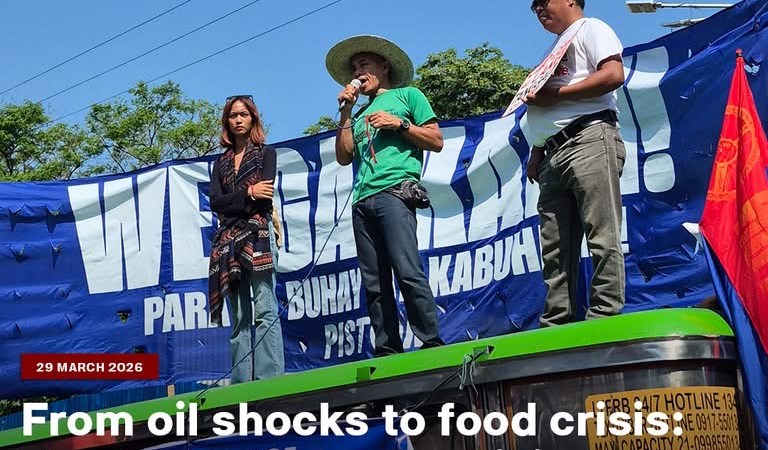
As the US and Israel war against Iran in the Middle East enters its first month today, Filipino farmers and fisherfolk are being pushed deeper into debt and hunger as persisting oil price shocks batter the country’s already fragile agricultural sector, the Kilusang Magbubukid ng Pilipinas (KMP) said.
KMP slammed the Marcos Jr administration anew for inaction, stressing that rising fuel prices are driving upthe cost of irrigation, transport, fertilizer and pesticide use and the entire production process. “Ang natitira na lang sa mga magsasaka ay utang. Habang tumataas ang presyo ng langis, sumasabay ang pagtaas ng gastos sa produksyon. Hinahayaan din ng gobyerno na walang kontrol sa presyo ng farm inputs. Presyo lang ng ani ang palaging mababa,” the group said.
In Malolos City, farm worker Divina Velasco sold fresh palay at only Php10 per kilo and Php15 per kilo for dried palay during the December 2025 harvest. In their 1.5 hectare-plot, her family harvested just 24 cavans due to impact of calamities, insufficient to cover her Php35,000 debt. “Sa palay, mamumuhunan ka ng Php40,000, hindi rin sasapat kasi uutangin mo,” Velasco said, pointing to the deepening cycle of debt among farmers.
Fertilizer prices also continue to surge, with urea now at Php2,200 to Php2,400 per 50kg bag and complete fertilizer at around Php2,100, from Php1,600 to Php1,750. KMP stressed that the Department of Agriculture (DA) and the Fertilizer and Pesticide Authority (FPA) have the authority under the Price Act of 1992 to impose price controls but have refused to act. Instead, the DA offers token subsidies and delayed assistance that fail to bring down actual production costs.
Also In Bulacan, farmer and tricycle driver Marcelo Hernandez of the Nagkakaisang Magbubukid ng Malolos (NMM) has cut irrigation from three cycles to just one due to high diesel prices. Farmers often use diesel for their water pumps. “Kung dati tatlong beses magpatubig, ngayon isang beses na lang. Kapag tumaas pa ang presyo ng diesel, sa ulan na lang talaga aasa. Mababa ang presyo ng palay pero mataas ang presyo ng inputs kaya lugi talaga,” he said. Still in debt from the last planting season, he has also reduced tricycle trips to save fuel. “Dapat bumaba ang presyo ng petrolyo para kumita naman ang magsasaka at hindi utang lang ang natitira,” he added.
In Navotas City, Norma Maluenda’s family, who rely on mussel fishing, face the same crisis as rising fuel costs eat into already meager earnings.
KMP said the Marcos Jr government’s criminal negligence to lower oil prices benefit oil companies. “Without immediate and concrete measures to control prices of oil and farm inputs, the country is heading toward a deeper food crisis.” The group also demands genuine and significant production support, saying that the token and limited P2,325 cash assistance for farmers and farmers is too little and too late.
“Kung hindi pakikinggan ng gobyerno ang panawagan na alisin na ang excise tax at VAT sa langis at kontrolin ang mga presyo, hindi lang kabuhayan ng magsasaka ang babagsak, pati suplay ng pagkain ng buong bansa ang malalagay sa alanganin,” KMP said. “Habang kumikita ang malalaking kumpanya ng langis, mamamayan ang pumapasan ng bigat ng krisis na pinatindi pa ng gera ng US,” said Ronnie Manalo, KMP secretary general. ###

