
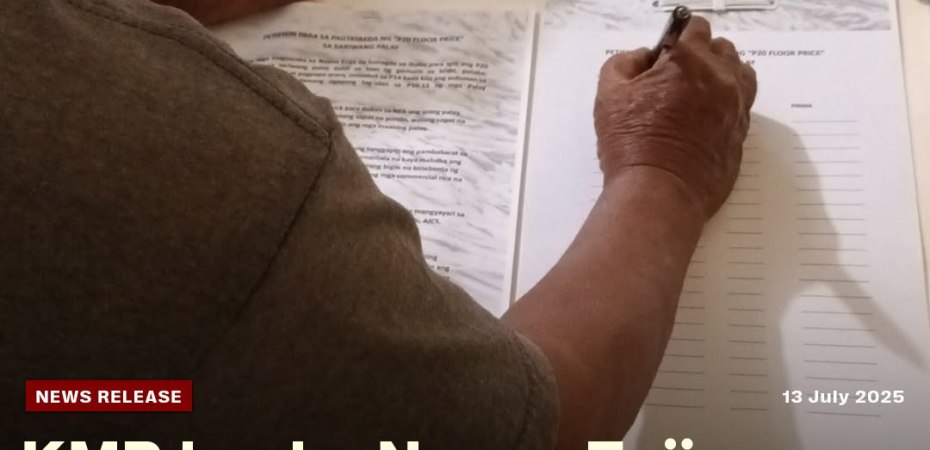
The Kilusang Magbubukid ng Pilipinas (KMP) expresses its strong support for the 199 rice farmers from Barangay Bantug, San Roque and other villages in Guimba, Nueva Ecija, who have formally petitioned for the immediate imposition of a Php20 per kilo floor price for fresh palay. The farmers are sounding the alarm on the collapse of palay prices, which have plummeted to Php10 to Php12 per kilo, and even lower in other villages, well below the production cost. The demand to increase palay prices is not just reasonable, but necessary for their survival.
“Nalulugi ang mga magsasaka sa bawat anihan. Binibili lang ng traders sa Php10 hanggang Php12 kada kilo ng palay. May mas mababa pa sa P8 hanggang Php10 kada kilo. Saan ka pa pupulutin niyan?” lamented KMP Chairperson Danilo Ramos. The farmers, many of whom lack access to drying and transport facilities, are also unable to sell to the National Food Authority (NFA), which remains largely absent from the market.
Ramos echoed the urgency of the farmers’ call. “Dapat pakinggan ng pambansa at lokal na gobyerno ang panawagan ng mga magsasaka. Doble pahirap ang Rice Liberalization Law at ang pagbagsak ng presyo ng palay. Nararapat lamang ang Php20 na floor price para sa sariwang palay upang matiyak ang kabuhayan ng mga magbubukid. Matagal nang ipinapanawagan ng KMP na dapat bilhin sa Php20 pataas ng kada kilo ng palay.” he said.
KMP has consistently pointed out that RA 11203, enacted in 2019, has been catastrophic for local rice producers. The law removed quantitative restrictions on imports in favor of tariffs, which were supposed to fund competitiveness programs. Instead, the market was flooded with cheap imported rice, driving down the price of locally produced palay and squeezing small farmers out of the supply chain.
In its policy reviews, including its critique of the Marcos administration’s midterm performance, KMP argued that RA 11203 stripped farmers of state protection and placed the entire industry in the hands of private importers and traders. RCEF or the Rice competitiveness Enhancement Fund, the supposed compensation mechanism, has failed to reach the poorest farmers. Mechanization and training programs were implemented with limited scope and accountability, favoring large, well-connected producers. Meanwhile, the NFA’s diminished role has left farmers with no reliable buyer during the harvest season.
KMP said the catastrophic damages wrought by Rice Liberalization are irreparable. Following the passage of RA 11203, farmgate prices for palay collapsed, plunging by as much as Php7 to Php10 per kilo and resulting in massive losses for farmers. At the same time, rice imports surged from 2.2 million metric tons in 2018 to nearly 3.9 million metric tons in the following years, displacing local production. The distribution of Rice Competitiveness Enhancement Fund (RCEF) benefits also proved uneven, with large-scale beneficiaries receiving the lion’s share, while the majority of small farmers received little to no support at all. Complicating these issues, the National Food Authority (NFA) was barred from procuring domestic palay aside from buffer stocking, effectively removing a key market support mechanism for local producers.
“Pahirap sa magsasaka ang pagpapatuloy ng RA 11203 at maging ang amyenda nitong RA 12078. Lalo lang nitong ibinaon sa utang at kawalang-kita ang mga magsasaka ng palay,” Ramos emphasized. “Ang mga traders at importers lang ang nakinabang. Matagal nang dapat ibinasura ang batas na ito.”
Despite President Marcos Jr.’s campaign promise to support the agricultural sector and his year-long stint as concurrent Agriculture Secretary, his administration has neither repealed nor amended RA 11203. Instead, his government has leaned further into importation policies that perpetuate market dependence and rural poverty.
KMP said the petition of Guimba farmers is emblematic of a national crisis in palay prices affecting millions of Filipino rice farmers. The group reiterates that the immediate imposition of a Php20/kilo floor price must be coupled by the repeal of RA 11203, restoration of NFA’s mandate to procure directly from farmers, and significant post-harvest support including drying, storage, and transport infrastructure.
“Ang laban para sa pagpapataas ng presyo ng palay ay laban ng lahat ng magsasakang Pilipino. Dapat itong suportahan ng publiko at aksyunan ng gobyerno.” ###

