
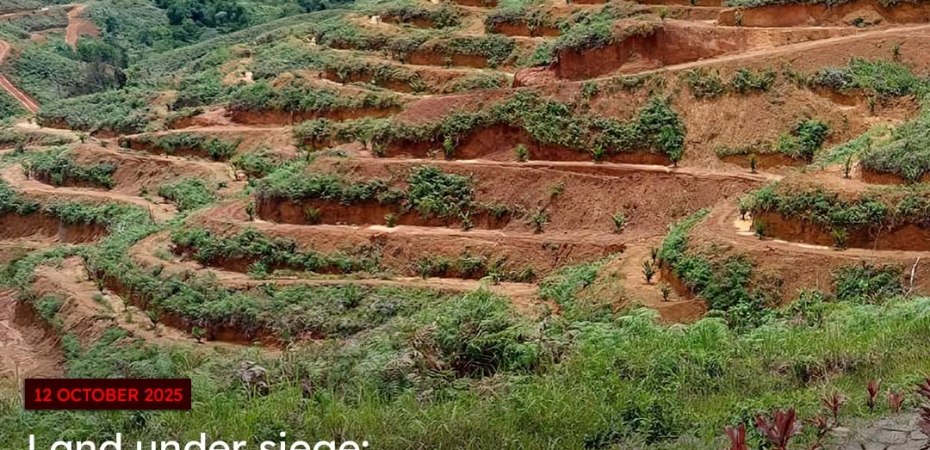
In the rolling hills of Candoni, Negros Occidental, generations of farmers have coaxed life from the soil – planting rice, corn, sugarcane, pineapple, and vegetables that feed families and communities. For more than sixty years, their hands have tended this land, passed down through generations. But today, this heritage is under siege.
A Php2-billion palm oil plantation project, led by Hacienda Asia Plantation Incorporated (HAPI) associated with the Consunji family, threatens to convert 6,652 vast hectares of farmland and forest into monoculture plantations. More than 300 farming households, including the Ati Indigenous community, face eviction from lands their ancestors have cultivated for decades. Bulldozers pave where children once played, and promises of “no displacement” crumble under the weight of heavy machinery and corporate contracts.
HAPI’s project operates under an Integrated Forest Management Agreement (IFMA) with the Department of Environment and Natural Resources (DENR), giving it sweeping rights over public forest and ancestral lands. But behind the legalese lies a stark reality: displacement, loss of livelihood, and environmental destruction. Communities are losing farmlands that sustain them; workers face exploitative conditions with meager pay; and pesticides threaten the soil and waterways, turning fertile lands barren.
Farmers and Indigenous peoples are fighting back. They are exploring legal remedies, filing for a Writ of Kalikasan, and demanding the revocation of the IFMA. They resist intimidation, red-tagging, and militarization, asserting that “development” cannot mean displacement and ecological destruction. For years, environmental groups have called for transparency because the Comprehensive Development and Management Plan, Environmental Compliance Certificate, and business plan remain undisclosed, raising serious questions about accountability.
In June 2025, mounting public pressure pushed the LGU to demand the suspension of all “earth-moving” activities by HAPI Inc. The Environmental Management Bureau of Region VI soon followed with a formal Cease and Desist Order (CDO), citing the company’s failure to secure an ECC and ongoing violations of environmental regulations. This marked a significant shift, especially for the local official who had once praised the palm oil project as a “shining gift from the sky.”
Despite HAPI’s claim that earth-moving has stopped, local groups report that planting continues, demanding more than a temporary pause. For the farmers and IPs, this is not a mere issue of regulatory non-compliance but the very harm that the project brings. As grassroots alliance SAVE TABLAS put it, “Even if the plantation is declared legal and complete with documents, it still endangers our land, water, food, and lives.”
The Candoni case is not isolated. It reflects the broader struggle of rural and Indigenous communities across the Philippines, where semi-feudal land relations leave farmers vulnerable to corporate encroachment.
In Negros, the “sugar bowl of the Philippines,” farmworkers survive on paltry wages, seasonal labor, and debt. Now, new threats loom from corporate plantations and so-called green development projects.
Yet, farmers and farmworkers continue to resist. Through collective farming, legal actions, and community solidarity, they assert their right to land, livelihood, and life.
This October Peasant Month, know more about the lives and struggles of Negrosanon farmers as they bring to Manila their demands and grievances at the Kampuhang Magsasaka.

