
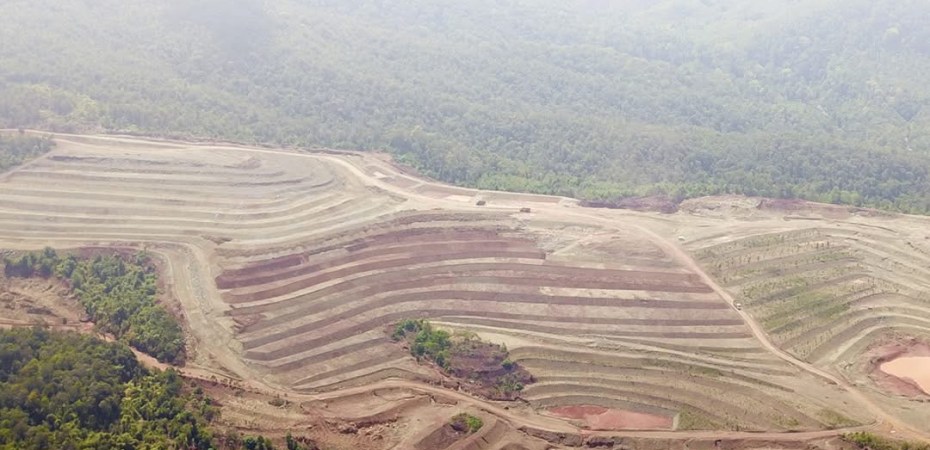
As the country marks the 31st year of the Philippine Mining Act of 1995 or Republic Act No. 7942, farmers and environmental advocates are intensifying calls for the repeal of the country’s mining policies, citing deepening impacts on agricultural lands, rural livelihoods, and community rights.
Rice farmers in MacArthur, Leyte are urging the Lower House and Senate Committees on Natural Resources to immediately investigate the effects of black sand mining operations on rice production, irrigation systems, and coastal farmlands. Communities in Barangay Maya and nearby villages report declining yields, saltwater intrusion, damaged irrigation, and soil degradation linked to extraction activities of Strong Built Corporation. Farmers warn that continued mining operations threaten not only their incomes but also local food security.
Danilo Ramos, chairperson of Kilusang Magbubukid ng Pilipinas (KMP), said three decades of liberalized extractive policies and bias toward large-scale mining corporations have wrecked our natural and mineral resources. “Sa loob ng 31 taon, ang Mining Act ay nagsilbing legal na sandigan ng malawakan at dambuhalang pagmimina na pumapabor sa malalaking kumpanya habang inaagawan ng lupa at pinapalayas ang mga magsasaka at katutubo,” Ramos said. “Sa Leyte, malinaw ang naging epekto, nasira ang mga palayan at kabuhayan para sa kita ng iilan.”
The situation in Dupax del Norte, Nueva Vizcaya has further fueled national debate after residents erected barricades earlier this year to oppose mining exploration of UK-owned Woggle Corporation. The dismantling of barricades and arrest of protesters drew public condemnation. The Mines and Geosciences Bureau later suspended the exploration permit on grounds of force majeure, while Senators conducted inquiries into whether legal requirements for community consultation and environmental compliance were properly observed.
Ramos said these reflect problems embedded in the country’s mining regime, particularly the widespread issuance of Mineral Production Sharing Agreements (MPSAs). Under an MPSA, the government grants corporations the right to explore, develop, and utilize mineral resources in vast tracts of land for up to 25 years, renewable for another 25 years. These agreements effectively hand over control of mineral-rich areas, often overlapping with agricultural lands and ancestral domains, to private corporations under terms that prioritize extraction over ecological protection and food production.
“Binibigyan ng MPSA ng napakalawak na kontrol sa mga kumpanya sa loob ng kalahating siglo,” Ramos said. “The mining and quarrying sector in the Philippines contributes less than 1% to the national GDP, with recent data indicating a meager contribution of around 0.46% to 0.8 percent.
Public concern has grown further with the enactment of Republic Act No. 12253, or the Enhanced Fiscal Regime for Large-Scale Metallic Mining, signed into law in September 2025 by President Bongbong Marcos. While the administration says the law establishes a transparent and predictable tax structure designed to attract investors and generate an estimated average of PHP 6.26 billion annually from 2026 to 2029, critics argue that it strengthens incentives for large-scale metallic mining without first resolving longstanding issues of environmental damage, social conflict, and weak regulatory enforcement.
The law allocates 40 percent of mining excise taxes and royalties to local government units and 10 percent to research, exploration, and environmental protection, and mandates joint monitoring of mineral sales and exports by the Bureau of Internal Revenue, Bureau of Customs, and Mines and Geosciences Bureau. However, farmers’ groups contend that revenue-sharing mechanisms do not compensate for irreversible ecological harm or displacement of agricultural communities.
Ramos also criticized recent Department of Environment and Natural Resources administrative orders that streamline and accelerate the processing of exploration permits, MPSAs, Financial or Technical Assistance Agreements, and sand and gravel extraction permits for large-scale projects such as reclamation. “Pinapabilis ang permit at ECC, habang ang konsultasyon sa komunidad ay minamadali o binabalewala,” he said. “Todo-todo ang liberalisasyon sa pagmimina.”
The Marcos Jr. administration has positioned mining, particularly the extraction of critical minerals such as nickel and copper as central to the Philippines’ role in the so-called global transition to renewable energy technologies. Provinces such as Surigao del Norte and Surigao del Sur, which host extensive MPSA-covered nickel operations, are key to this strategy. Yet environmental and farmers’ groups warn that expanding nickel mining in these regions has already led to deforestation, siltation of rivers, and threats to farming and fishing communities.
Ramos urged the public to resist destructive mining and demand the junking of the Philippine Mining Act of 1995. “Panahon na para manindigan ang mamamayan laban sa mapanirang pagmimina,” he said. “Makiisa sa mga magsasaka, katutubo, at mga komunidad na apektado, ipagtanggol ang ating lupa, pagkain, at kalikasan laban sa mga dambuhalang minahan at korporasyon.”

