
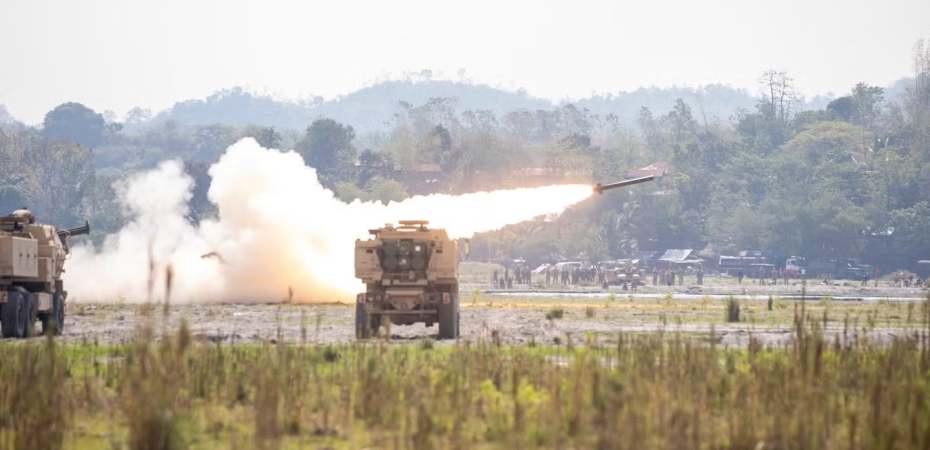
The Kilusang Magbubukid ng Pilipinas (KMP) strongly condemns the ongoing and expanded Salaknib–Balikatan (SABAK) military exercises, saying the large-scale and increasingly multinational war games are intensifying the burden on Filipino farmers and fishers.
While Salaknib and Balikatan are distinct but related activities under broader Philippines–United States military cooperation, KMP said their combined and overlapping implementation is effectively turning large parts of the country into extended military zones.
This year’s Salaknib exercises involve around 7,000 troops from the Philippines, United States, Japan, Australia, and New Zealand – one of the largest iterations to date and the first with direct participation from Japanese and Australian forces.
KMP noted that Salaknib, which began April 6 in Luzon, serves as a precursor to the larger Balikatan 2026 exercises scheduled from April to May, followed by a second Salaknib phase extending until June.
The Balikatan 2026 is expected to be the largest iteration of the annual Philippines–U.S. joint drills, expanding beyond bilateral exercises into a multinational undertaking. In addition to U.S. and Philippine forces, Japan will deploy around 1,000 personnel – marking one of its most significant overseas military engagements alongside participation from Australia and, for the first time, France, with naval assets such as the FS Dixmude and FS Aconit taking part.
KMP emphasized that Balikatan 2026 will involve advanced and large-scale training across multiple locations nationwide, including northern Luzon, Palawan, Visayas, and Mindanao. These include maritime and coastal defense drills, amphibious landings, air and naval operations, and live-fire exercises, as well as newer components such as cyber and multi-domain warfare.
“While military officials boast of ‘interoperability’ and ‘combined arms operations,’ the reality on the ground is displacement, restricted access to farms and fishing grounds, and heightened insecurity,” KMP said. Farming, fishing activities and even mobility are restricted in areas within and near the military exercises.
“Far from isolated drills, these war games now involve multinational and whole-of-government forces, amplifying their impact on civilian communities,” the group further said.
KMP also cited increased U.S. logistical preparations, including prepositioned equipment and the deployment of additional troops, vehicles, and aircraft. “These exercises include live-fire training, aviation operations, and multi-domain combat scenarios that pose risks to communities and the environment,” the group said.
“Farmers are forced to adjust planting cycles or abandon fields, while fishers affected by no sail zones lose access to fishing routes due to naval and amphibious drills. These disruptions directly threaten food production and the already meager rural incomes.”
The group warned that the growing multinational character of Salaknib and Balikatan expose communities especially near the West Philippine Sea to greater risk.
“Instead of prioritizing agrarian reform and support for food producers, the government is facilitating war games that damage farmlands, marine ecosystems, and rural livelihoods,” KMP said. The group also raised concerns over environmental damage, including soil degradation, deforestation, and harm to coastal and marine resources.
The group called for the immediate halt of the Salaknib–Balikatan exercises and urged the government to redirect resources toward strengthening domestic agriculture and ensuring food security. ###

